Introduction

Introduction: Mapping Out a Plan for the Rest of My Life and Enjoying the Journey

My Golden Years are an extension of the life I have lived up to retirement which began on December 1, 2011. I have organized this blog to include the top ten relevant topics shown below in the right side column in General Topics. Just click on one and you will see all that I have written on that topic. Click on the Most Current tab for chronological order of all entries.

I have addressed each topic in no particular order other than what is currently on my mind on the day I am posting. I started each topic by describing where I was when I began this blog and then exploring the possibilities of progression and any goals that I would like to meet. After that, I write about the path to reach that goal as it happens. Sometimes I just write about what is happening now.

I welcome any comments and questions either on this blog or email as I travel these paths and hope to share my growth with interested persons who may find some common elements in their own path to the rest of their life. I hope to use my skills as an appraiser for nearly 30 years to continue to observe different perspectives on a subject and reconcile into a conclusion that is of value to me. Please join me whenever you like. Email notice of new posts is no longer available so just bookmark the address.

The Blog Archive tool is helpful to find posts by year. Of most importance to me is the confidence developed in my intuitive skills over the years and it is that part of my character I am trusting to define value in my life. I believe change can be good and I can be enriched by believing in my true self using my intuition. The analytical part of my life no longer has a financial grip and I can let go of what absolutely made sense at the time in favor of what feels right now. I have done a lot of work since this blog began in 2011 and I hope you will join me as I explore this approach in My Golden Years.


Pages

Tuesday, October 28, 2014

Paving the Way Around the House

The New Stone Age

Rose Quartz and Clear Quartz Crystals


My husband and I have lived together in the Ozark Mountains since 1978.  Our 1978 home was built into a rocky hilltop above a river which required blasting into the solid rock that became two walls of the full walk-out basement.  Living on a steep hill required some creative landscaping.  Terracing began shortly after we moved into the house in 1986.  I think we may be done now in 2014 having completed all the gardens we want and the leveled paths and sidewalks for access.

Life takes many paths.  It is not the destination but the journey that gives life meaning.  Every project was an act of love as we grew together and shared the joy as we worked together.  Our home is the center of our life and, like our 40 year marriage, has evolved as an example of reaping what we have sown.  To celebrate our 40 year anniversary and the completion of major landscape projects in 2014,  our yearly trip to Hot Springs, Arkansas included just the the right symbols to bring home - crystals placed on either side of our new back steps that are located in the center of our home and yard.  We will  pass by them every time we go outside and it is the perfect place to sit.  It is the bridge between inside and outside, rest and work, and of being alone or together.  It is now time to sit and view the life we have built together.

The Rose Quartz Crystal is the stone of unconditional love and infinite peace.  It is the most important crystal for the heart; calming, reassuring, strengthening empathy and sensitivity and aids the acceptance of necessary change.  It encourages self-forgiveness and acceptance, and invokes self-trust and self-worth.  The Clear Quartz Crystal is the most powerful healing and energy amplifier on the planet because of its unique helical spiral crystalline form.  It absorbs, stores, releases, and regulates energy and is excellent for unblocking it.  It raises energy to the highest possible level.  It is a master healer. 
"Crystals have an extremely high vibration that raises consciousness and opens the higher chakras to communicate with other dimensions." The Crystal Bible, A Definitive Guide to Crystals by Judy Hall.  

Main Garden Terraces from front yard to back yard.  Vegetables on the right and flowers on the left.
Lower Terraced Gardens between Main Terraced Gardens and backyard; mostly lilies,  irises, and roses.  The garden shed is at the bottom on the left side of the photo.
This is where the Terraced Gardens join with the new sidewalk.
View from deck looking down on new sidewalk that joins the Terraced Gardens
View from deck looking down on the new sidewalk towards the north corner of the house.
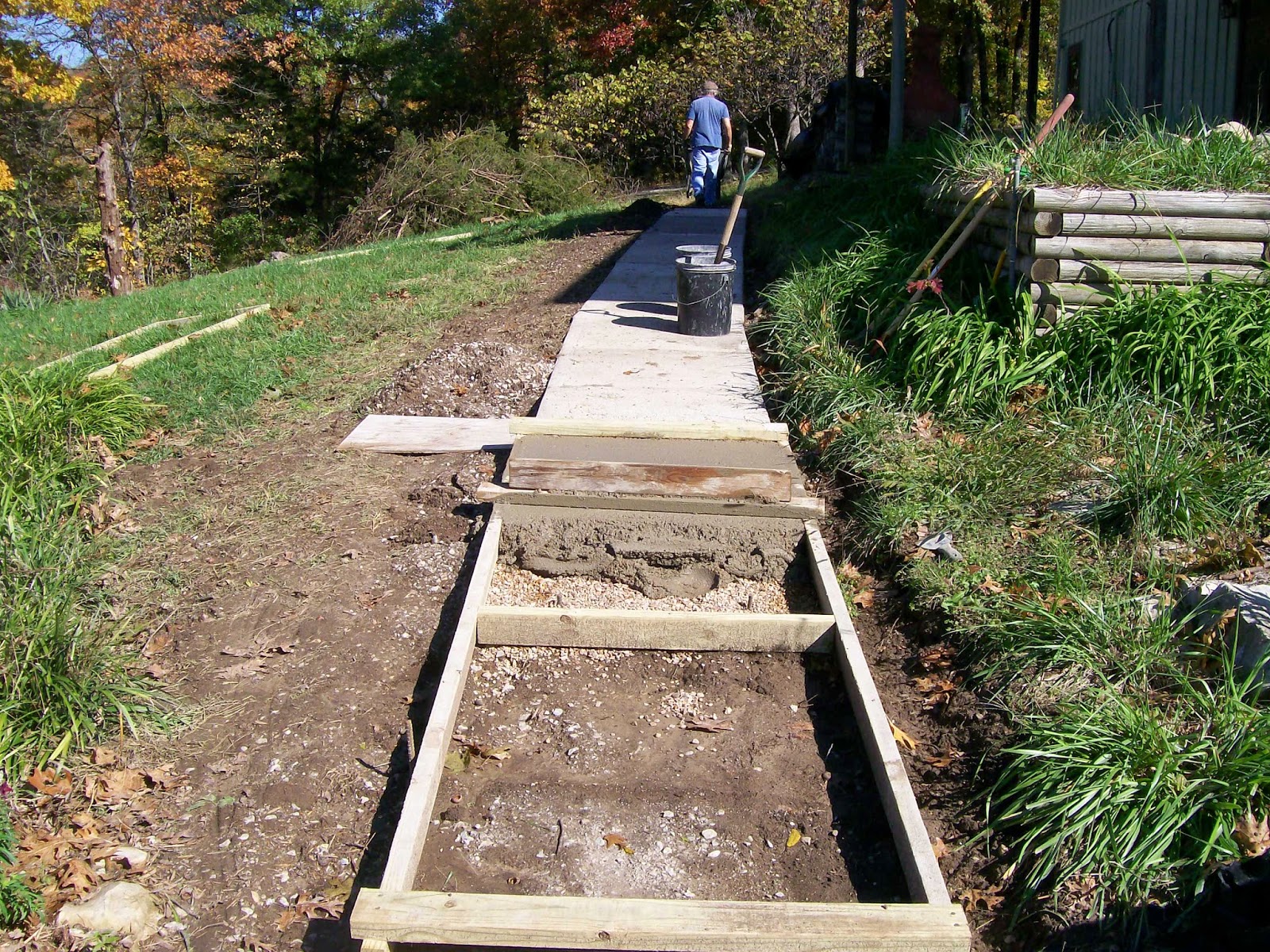
New sidewalk looking from north corner on left towards Terraced Gardens on right.
New sidewalk from north corner of the house to the front yard.  Bobi Kitty gave his stamp of approval by walking on it before the concrete set!
This is where the sidewalk joins the front brick patio…a very steep slope!
Bobi Kitty is checking out the last landscape project which is to be a small Native Plants Garden next spring.  The native rock and concrete retaining wall was in process of completion...
First, Keith scoops dry cement mix on top of the rocks set into concrete from a couple days ago...
Next, Keith sweeps off the dry cement mix to expose the rock faces and cover all the cracks and crevices...
Finally, Keith sprays water to wash off the dry cement mix from the rock faces and carefully blends the rocks and cement for an attractive native rock retaining wall.  


Last bag of concrete this year!  Sure have gotten our money's worth out of this old mixer bought in the early 1990's.

All the above photos were taken this last week of October in 2014.  We are expecting our first hard freeze in a few days.  The next group of photos were taken in 2012 and 2013 when the new sidewalk was begun.  It shows the preparation work…

First form laid had the local inspector checking to see if all was in order!  This wild vixen came around our yard a lot in October 2012 as she had a gimp leg and must have felt safe here.  Didn't see her in 2013.
After the sidewalk was completed along the length of the house, the connecting section were formed on the sloped joining it to the Terraced Gardens.

Transplants from under the oak tree were planted along the sidewalk in June 2012.
July 2012 had new block planters built.
Now in early 2014, the old wood retaining wall needed to be removed as it was one of the first projects and was now rotting.  The dirt behind it was very good and needed to be removed to a new location and will later be filled with gravel for better drainage so close to the house.
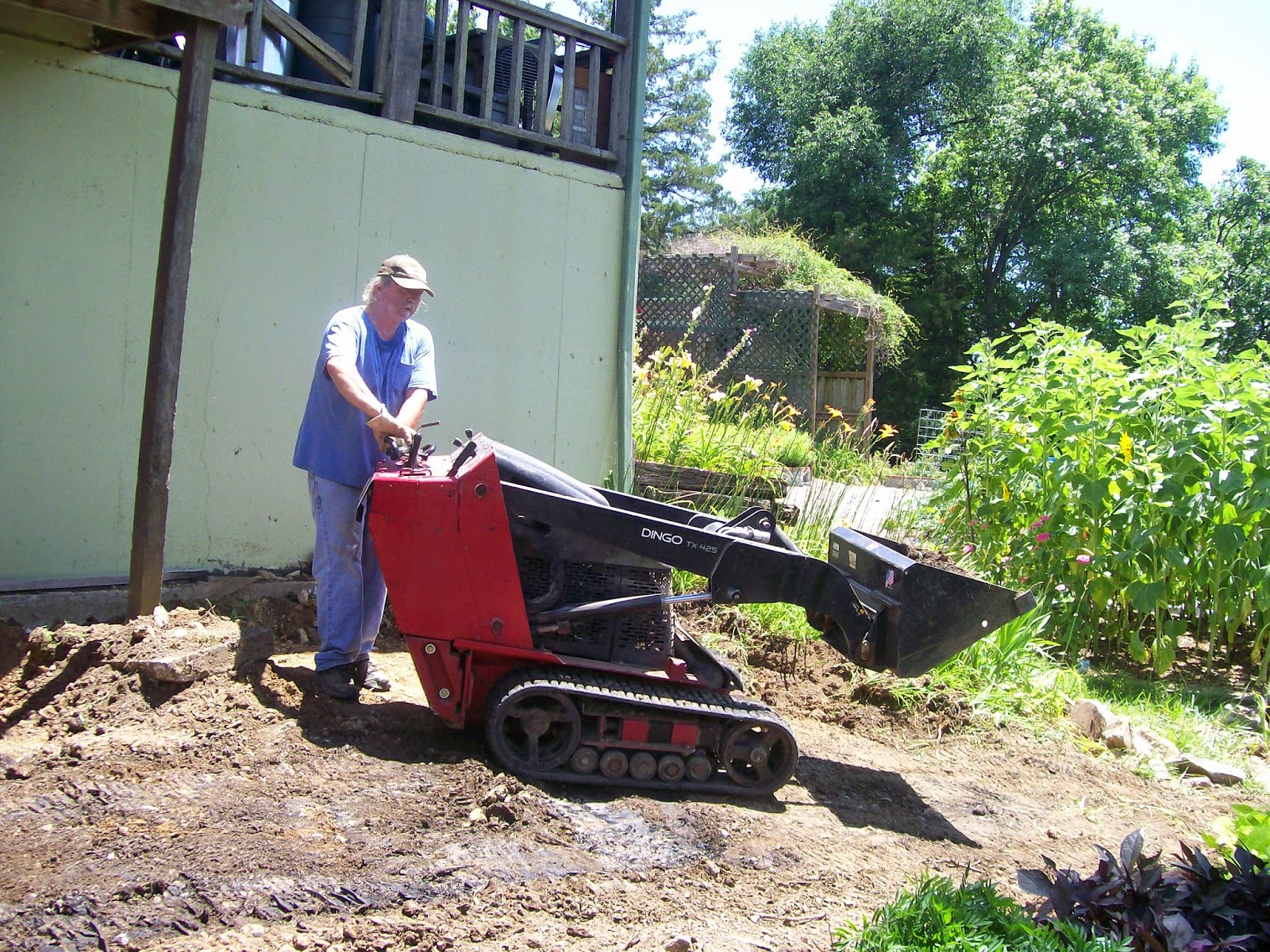
By summer 2014, we were ready to get moving.  After removing the old rotten wood retaining wall, the good dirt was hard packed from where we kept firewood and later used the concrete mixer when the basement floor needed re-leveling.  This large machine did the job of tearing out the wood and breaking the top layer of soil.  It was too big to maneuver around without damaging the deck; took out two support poles in the process!
We have rented this size machine before when we moved a lot of gravel around the gardens in earlier years.  It does a good job of digging and is small enough to maneuver well.  The good dirt here was moved to level out the washed-out slope on the north side of the house and to make a terraced native plant garden.
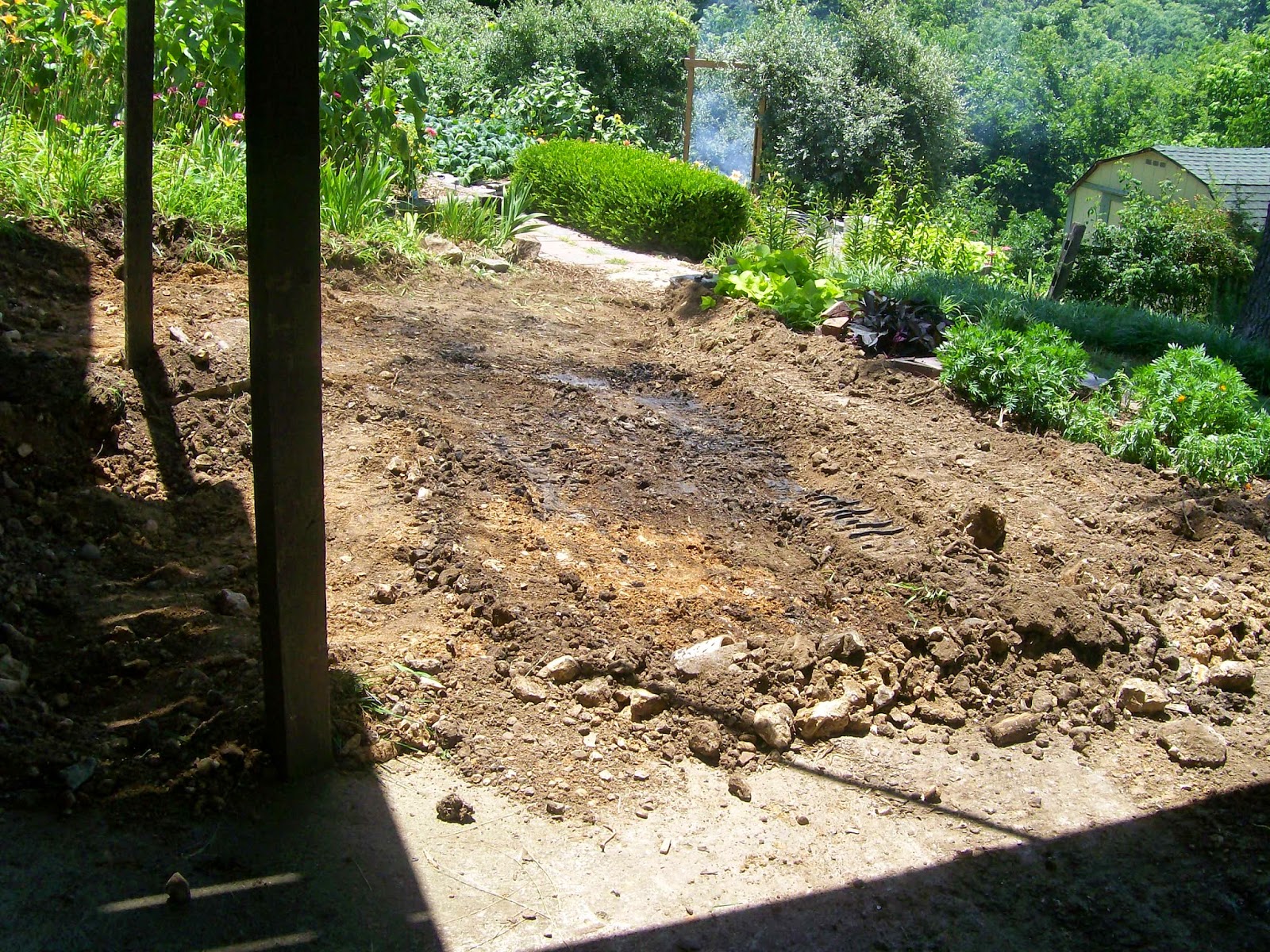
Took out all the good dirt until we hit the original rock.  Next spring we will fill with gravel and have a patio or fire pit area.
Good dirt was moved to level off this portion of the yard into a terraced native plant area.
Native rocks were roughly placed in the high end of this terrace and later were set in with concrete.
This is what the north side yard looked like before adding dirt and preparing for a sidewalk.  It is a steep slope with the front yard level with the main floor and the backside level with the basement entrance.  It was a big problem for many years washing out any attempts to plant grass so mulch was spread repeatedly.
This slope needs a concrete sidewalk before rain washes all the new dirt away.
We have completed all the concrete yard work for the year October 28, 2014.  Our path is clear and complete.  Time to enjoy the local wine trails...  

Wednesday, October 8, 2014

I Am A 2DamDays Kayak Race Winner!


2014 was the 5th annual 2DamDays Paddle Marathon put on by Lake of the Ozarks Watershed Alliance (LOWA) along with over 50 sponsors.  It is becoming one of the top annual events at the lake.  LOWA is a citizen based group who work to preserve, protect, and improve the Lake of the Ozarks, its watershed, and its natural resources, while maintaining the areas economic, social, and environmental health.  As a Missouri Master Naturalist, much of my volunteer hours are associated with LOWA.  This year, I participated in the race one day and volunteered to check in the racers on the second day.

My husband and I checked out the Dam2Dam Race for the first time in 2013 by supporting all the racers while learning more about the big picture.  We drove to all the sites the kayak racers put in beginning before dawn at the Truman Dam at Warsaw which is only about 30 minutes from our home in Hermitage.  We watched and learned from the experienced kayakers as we had just got our own kayaks but were not ready to actually participate in any race in 2013.  We got caught up in the excitement and vowed to be ready in 2014.  Use the "Search this Blog" tool on the right and type in "Kayaking in My Backyard" and you will see last year's blog article if you want to see our first year experiences as kayak owners.  I volunteered at all the monthly Kayak Meet-ups at Ha Ha Tonka put on by LOWA in 2014 and am involved in the newly forming Big Niangua River Trail which I blogged about recently and can be found just below this article or use the search tool. Unfortunately, Keith hurt his shoulder during the summer of 2014 and was unable to train himself for the race but he was a good coach and my support!

So I started to train on my local Lake Pomme de Terre which is just five miles from home.  Each Tuesday in August and September, Keith would take a part of his day off work to drop me off at the dam and pick me up 3-5 hours later when I called.  I started going from the dam to the Nemo Bridge.  Then I would go as far as the Pittsburg Marina and return to the ramp at Nemo Bridge.  When I got up to 14 miles, it was time to kayak the other arm of the lake which is longer.  Lake Pomme de Terre is shaped like a horseshoe with the dam at the north end about in the middle of the horseshoe.  The longer west side of the lake was about 16 miles from the Wheatland Ramp to Bolivar Landing and return to the dam and back to the Wheatland ramp.  There were very few motor boats during these times and sometimes I was all alone for miles and miles.  It was so peaceful and I got stronger and more skilled as the different weather conditions provided challenges.  My best time was 3.63 mph.  Average for my size kayak is 3.0 mph.  I'm as ready as I can be!

Pomme de Terre Dam

Nemo Bridge on Pomme de Terre Lake

Wheatland Park Boat Ramp on Pomme de Terre Lake

Turkey Vultures…don't stop...keep paddling!

After two months, I hoped I was ready for a much bigger Lake of the Ozarks challenge...


So race day was here.  The weather had been in the 80s when I practiced with only one day of 15-20 mph winds in one direction which was difficult and then I learned how much fun it can be to have the wind at my back and ride the waves on the return trip.  That practice day turned out to have given me more confidence which I really needed as race day was 12-15 mph with 30 mph gusts of wind and only 47 to low 50 degree weather.  I had to be brave for this challenge.  I was anxious and didn't know if I could go through with it up until I got in my kayak minutes before the race started.  I found my courage and decided I should at least finish the race. 

Ready…Set….Go and Just Finish the Race!!!!!

The evening before, there was a dinner and safety meeting in Warsaw for all racers.  There I met everyone and sat and ate with an Extreme Woman Solo Racer, Susan Tretter, who had done this race last year.  She assured me that there are plenty of support boats and she never felt abandoned.  Come to find out there was one support for every two racers.  That helped me a lot to feel reassured!  I had never kayaked Lake of the Ozarks and was unfamiliar with it other than by map.  It was at this time that the entry was closed and I found out I was the ONLY woman solo racer in the under 15' kayak race for the Sweet 16 portion!  I was sure to win as long as I finished the race.  Susan was one of two women in the Extreme Limited race which was for the 2 days and the full 80+ miles.  On the day of the race, her opponent didn't show so Susan also just needed to finish the race.  There was one other solo woman in the Extreme Unlimited and she was unopposed.  The only other women in the main two races were part of tandem teams with a men.  There were at least a half dozen 'no shows' on race day.

You can click on the 2DamDays Paddle Marathon link to see the race specifics but here is a summary:

There were 3 different races with a total payout of $10,914.58; the average payout per racer at $682.16:

1.  Extreme (Limited and Unlimited each broke down further by Solo Men, Solo Women, and Tandem) - 80+ miles in 2 days.  Speeds were 4.76 to 7.72 mph.  The solo man who won did 7.72 mph and his name was Carter Johnson from Sausalito, California.  Mike Herbert from Rogers, Arkansas was the reigning champion and was a three time Olympic and World Champion.  He came in seconds behind Carter.  This is where most money is won and brings competitors worldwide.  This year racers came from seven different states for all races. The differences has to do mostly with kayak size and types.  There was only one woman in each of the limited and unlimited races so they both won 1st place unopposed with speed averages of 4.76 and 4.90 mph.

2.  Sweet 16 (Unlimited, 15'-18',  Under 15' each broke down further by Solo Men and Solo Women; I was the only woman) - Actually 15.5 miles in about 3-4 hours.  There were 10 actual participants as 2 solo men didn't show up; the solo man in my class was unopposed (Gary Wiggins).  Of that 10; 4 were in tandems so actually there were 6 separate solo racers.  Gary and I came in at the exact same time at 4.12 mph and the other 4 solos ranged 5.53 to 5.85 mph.  So it seems that I raced the same as a solo man in my Under 15' and only about an hour behind the other solo men in much bigger kayaks.  The Unlimited included one of the tandems and the other tandem was 15'-18'.  I won 1st Place Woman Solo Under 15'.  I got a certificate and a little money and a whole lot of fun!

3.  Anything Goes (Solo Men, Solo Women, Tandem) - 3.5 miles in about an hour or two.  12 showed up out of 14.  Some kayakers dress up themselves and their boats for fun.  There are even some other crafts such as tandems, canoes, and paddle boards.  The speeds were 1.49 to 3.23 mph.

I did my personal best in speed as 3.63 mph was the best I could do in practice.  The wind helped a lot this day and combined with the added adrenaline of the race, my time of 4.12 mph was more than I expected especially when my goal was to just finish the race and get to the finish line at Captain Ron's Bar & Grill by awards ceremony!  I didn't need to compete with anyone but myself and the harsh weather conditions.  For fun, I would paddle along and visit with Gary who was also just wanting to finish.  We were not competing against each other and would each be 1st place in our own classes just by finishing.  Still, that was easier said than done!

My challenges were to keep my kayak from capsizing in the 15 mph winds with 30 mph gusts by mostly steering it in the right direction.  The WNW wind, when caught just right, moved me faster than I could ever paddle so a lot of the time I held my paddle up over my head to keep it from slowing me down in the waves.  That was the fun part and the safety boat was filming Gary and I as we rode the waves.  I hope I get to see that video sometime.  My direction was west but also north and south on this winding lake.  Definitely had to pay attention all the time and missing a few strokes at the wrong time could easily get the kayak hit with a wave and over I would go!

I had my cell phone alarm set on each hour so I would be reminded to eat and drink.  Being diabetic, I figured out what I had to do to keep up my energy for an insulin resistant condition in a high stress racing mode.  It was not easy balancing the paddle with granola bar, banana, energy drink, and water all the time trying to ride the waves and not get capsized!  Then the final 3.5 miles, the wind was from the west and I turned straight south to the finish line.  There was no eating/drinking as it was hard work the whole way just to keep moving and not getting blown over!  I somehow managed to call Keith as I was going under the bridge about 15 minutes before turning into the safe cove with the finish line at Captain Ron's Bar & Grill.  I almost crashed into the bridge piling in the few seconds I made the call to be sure Keith was at the dock to greet me.  I was coming in much earlier than we had expected!

Victory is Mine!
I joined back up with Gary that last mile so we could come in together although I had been ahead of him most of the time and he crossed the lake a couple more times than I did.  It just worked out that we joined back up and we were checked in at the exact same time.  Keith was in place to take some good photos at this point and the rest can be seen in this musical photo album I put together below.

2104 2DamDays Sweet 16
1st Place Women Solo
Under 15 Feet 
At the Awards Ceremony, I was the only woman that had made it in by that time.  Some of the Extreme Racers were in also but many were still out.  They started at 7 am Truman Dam and Sweet 16 started at 10:30 am at Red Fox Marina.  All the Sweet 16 racers were in.  The Anything Goes racers were mostly scattered with at least one of the two winners in the awards ceremony.

2014 2DamDays Day 1 Awards
(all kayakers that were in by ceremony time)

My musical photo album continues to the next day at Beavers at the Dam where I worked as a volunteer for LOWA helping to check in the Extreme Racers for the finals.  It starts with several photos of the top two Extreme Racers, Carter and Mike, who were only seconds apart!  I took photos of most of the racers as they came in, the final awards, and packing it all up.  Every photo is in the correct order of events.  You can follow the whole story from my perspective by clicking below…


Monday, September 8, 2014

Big Niangua River Trail Maiden Voyage


"Take nothing but photos, 
Leave nothing but paddle wakes, 
Kill nothing but time."


August 26, 2014 was the first time Missouri Master Naturalists set out together to mark the points of interest established for the proposed Big Niangua River Trail.  Niangua translates to "Big Winding Stream of Many Springs" by the Indigenous Osage People.  This project is jointly sponsored by Lake of the Ozarks Watershed Alliance (LOWA), the Missouri Department of Natural Resources Division of State Parks, the Lake of the Ozarks Chapter of the Missouri Master Naturalist Program, and Ameren Missouri.

Although this trail starts at Ha Ha Tonka State Park and goes up river instead of down river, either end can be a put-in site.  The total distance is 11.5 miles from the Kayak Steps at Ha Ha Tonka to the Whistle Bridge.  It is partly a flat water trail and the boundary between Lake of the Ozarks and Big Niangua River will be one of the 20 points of interest that will be posted with a sign because harvest regulations differ above and below this point from the standpoint of fishing.  Currently, the final draft of the brochure, the information sign boards, and the actual points of interest signs on each site are in the final stages and likely will be ready and in place for the public late 2014 or early in 2015.  This Maiden Voyage by the Missouri Master Naturalists was to visually determine the best locations for the signs at the interest points and mark them with a bright pink plastic tie until the metal signs are completed.  Also, permission letters to place the signs are being mailed to property owners.  Many photos and notes were also obtained before the final drafts are made.  It was a productive and fun seven hours on a beautiful, hot summer day for the 14 kayakers!

Here is some of the information we have so far which shows the points of interest in bold type followed by a music photo album I made for fun for our Maiden Voyage:

The Whistle Bridge is a low water crossing and is considered an access point but there is no public parking.  For this trip, we skipped this point and put-in at the west side of Mother Nature's Campground 2 miles from the Whistle Bridge going north which is down river.  There are two good fishing holes, Nettle Hole and Flat Rock Hole before the second access point of Mother Nature's Campground on the east side of the peninsula; all owned by the campground.

The first stop we made and got out was at Tunnel Cave.  This cave is a natural cave system connecting one part of a loop in the Niangua to a second part of the loop almost seven miles down river.  When the cave was flooded to generate electricity with Tunnel Dam, too many side passages provided too many leaks and a new tunnel for generating electricity had to be drilled.

Tunnel Dam and Gauge House was constructed in 1929 and is located about 6.5 miles downstream from Tunnel Dam.  Water from the lake arrives at the powerhouse through an 800 foot-long tunnel constructed through the ridge.  There's a 40' drop in elevation from the lake surface to the powerhouse which contains two hypo-turbines capable of producing three megawatts.  The old gauge tower, located .3 miles downstream from the powerhouse was decommissioned in 1969.

There is an outcrop of large dolomite boulders extending out from the left bank of the river providing a significant eddy downstream and is a good place to catch bass and the occasional walleye.  It is known as Susie Rocks.  The story behind the name remains a mystery.

In the 1800s-1900s, settlers cut lumber for railroad ties.  The Tie Bank and Wetland Area is where rafts of ties were launched into the river on their way to market.  Up to 50,000 ties were stacked at one time and sent down the river as rafts up to 2500 ties.  The cutters were often paid in scrips or IOU bills for the stores owned by the tie buyers.

For a little excitement, the left-hand channel at this split in the river provides a short, narrow, fast-flowing, and somewhat tricky chute.  It is known as the Gauntlet.  There is only room for one water craft at a time so be sure to listen for jet boats before entering.

A good time for a break would be Casa de Loco Winery.  It has a very interesting history you can ask the staff about whether you take-out and hike up the hill or drive here off Highway 54.  Kayaks and canoes are available to rent as well as shuttle service.  For more information see their website:  casadelocowinery.com 

Rodgers Ford was designated as a "populated place" in the 1800s with a scattering of buildings and permanent population.  It later was designated as part of the area, Hahatonka quadrant, and was abandoned.  Slough Area is a smaller, alternate channel for the river to follow often formed during flood times as the river cuts new paths.  On the Niangua, sloughs generally are found in areas of islands and are often narrow and provide good fishing.  Next is the Boundary LOZ and BRN which is the accepted boundary between Lake of the Ozarks and the Big Niangua River.  

Rooffener Tie Slide is a bluff where the remains of a chute where logs were cut and slid down the hill to the river.  The forests were heavily cut in the late 19th century for railroad ties.  Woodlands Park Landscape is part of Ha Ha Tonka State Park.  It has three primary natural communities that work together to form a harmonious mosaic that stretches for over 3700 acres.  These three communities: dry chert woodland, dolomite glade, and upland flat woods represent some of the best remaining examples of these environments in Missouri.

Wetland Area is a good observation point for water birds including herons, osprey, ducks, and geese.  Aquatic life includes turtles, carp, gar, and gar.  The vegetation includes rose mallow, lizard tails, Paw Paws, and an assortment of sedges and rushes.  Wetlands are the beginning of the food chain with invertebrates which clean the water and are food for fish and other water species.

Onyx Cave entrance is right on the river and is easily accessed by boaters who can float about 70' into the cave.  Onyx mining in Missouri caves was tried as an industry in the late 20th century and there is some interesting history here…not so much onyx though.

Another outdoor venue is Sugar Loaf Winery with good access from the river and also by vehicle off Highway 54.  Good food and wine are available as well as kayak rentals and shuttle services.  It is just upstream from the Ha Ha Tonka State Park and would be a great destination in itself if parked at Ha Ha Tonka and putting in at the Kayak Steps and return.  For more information about what the winery has to offer see their website:  sugarloafwinery.com

At Spencer Creek and Bank Branch Creek, two spring fed creeks combine with Ha Ha Tonka spring which add depth and clarity to the water.  Larger boats have difficulty navigating because of the shallow water and submerged logs.  Between 1830 and 1835, a gang of counterfeiters operated in this area using the steep terrain and local caves to hide their operations.  Bank Branch was named because this is where they deposited their counterfeit money aboard barges for the trip East.


Sunday, September 7, 2014

Bobi Kitty's First Year Adventures


Like Alice and the Cheshire cat from Lewis Carroll's Alice in Wonderland, adventures in your own backyard can lead to big changes in life.  A stray young American Bobtail cat came into our yard just as summer began in 2013.  He was immediately challenged by the next door neighbor's Hemingway cat named Tuffy.

We didn't mind having Tuffy come around our yard although he was not all that friendly as he scratched us when we tried to pet him and menaced my bird feeders and bird houses much to my irritation.  So I tried to get the new cat to go back to wherever he came from so as to potentially not increase the problem.  I tried yelling at him with a broom in hand gently pushing him away.  He would not leave and knew I would not hurt him.  After about a week of this persuasion, I began admiring his persistence and left out food and made a bed basket for him in the dry carport.  Soon he let me pet him. I say "him" but at that time he was too young to identify either way.  I gave him the neutral name "Bobi" and later "Bobi Kitty" as he showed up while I was tending my gardens.  I repeatedly told him, "You can be my Garden Kitty but you are not coming inside!"  So we got used to each other.

We didn't need to trap him like so many wild critters that came into our gardens which we then relocated to "lakefront property." Bobi Kitty didn't bother the birds but loved to sit with me and watch them.  He must have felt comfortable enough in our yard and carport to decide to call this place his home.  He was definitely a "people kitty" as he would like to be around us and watch what we were doing and he seemed to like us by letting us pet him.  Of course, feeding him everyday and treating him with kindness helped.  Also, he was very young and not set in his wild ways yet.

Then it got cold.  Bobi was definitely a male cat by the first freezing nights in mid-October.  He defended his new home from Tuffy and there were some cat fights.  Bobi held his own but Tuffy had always been much bigger and had 6 claws on each foot tipping the scales in his favor.  Bobi learned to fight but not after some deep scratches to his face and head.  From the amount of orange fur remaining in our yard, Tuffy got his share too.  Finally, I said enough was enough and decided that if Bobi wanted to come inside and be more of a family cat, he would have to be neutered.  I began to leave the door open a little longer each time I went inside to see if he would follow.  He finally chose to come inside a little bit farther each time with me letting him outside whenever he wanted.  Then he let me clean his scratches and brush him regularly.  Getting him in a carrier inside my car for a trip to the vet was a wild time!  He made some howling sounds that made the hairs on my neck stand up!  So after that procedure on November 25th, Bobi started to settle down some.  Bobi also got all his recommended vaccinations.

The vet aged him at 6 months giving him a birthday of April 15, 2013 which means he must have been 6-8 weeks old when we first met near the end of June.  Bobi still went outside during the day and came inside most nights and whenever he was hungry or was lonely.  When we were home, he was usually around.  It was a nice Christmas with Bobi here as we had no family around that year.  He got lots of presents and attention.  He found several comfortable places including the basement when he wanted to be alone, sitting by me on my hassock, looking out the window at birds, or sleeping in a basket near our bed.  Bobi Kitty was truly a part of our family now.

For our 40th Wedding Anniversary in May 2014, Keith and I went to Hot Springs, Arkansas for a week.  We left Bobi outside with a neighbor boy across the street coming over twice a day to feed Bobi and check if he is okay.  Everything went well and he said Bobi never missed a meal and he saw him regularly.  Bobi truly wanted to call this house his home even when we were gone.

A couple weeks after we got home, Bobi didn't come home.  I kept looking for him and calling him every evening and morning for his meals and watching for him in the yard during the day.  No Bobi Kitty...I was sad to think something happened to him or he decided to live somewhere else.  After 5 sad days, I almost gave up.  Then, there he was!  He was hopping on 3 legs across the front brick patio all skinny and scruffy with a wound in his side!

Bobi came inside and ate two bowls of food and a whole bowl of water before going to sleep on his blanket in the living room.  I let him rest as I was on my way out the door to run a 5K race nearby below the dam.  Keith was here to watch Bobi.  When I got home a couple hours later, it was decided that we should take Bobi to the vet to see how bad he was as he put no weight on his back leg.  The vet X-rayed and it showed Bobi was shot!  The bullet entered his gut but miraculously didn't do any internal damage there.  The bullet splintered his femur (thigh) and shattered his knee.  We saw in the X-ray that there were dozens of bone fragments and bullet pieces.  The vet said that cats do better than dogs with such an injury as their bones will heal faster but the leg would not be normal and the pieces of bone and bullet could not be removed but would have to work their way out or stay in which could cause future problems.  The other option would be to completely remove the leg and healing would be faster and likely no future pain unless arthritis sets in the good leg for excess use by old age.  The vet suggested we leave Bobi overnight to see if setting the leg in a splint is tolerated; if not, then removing the leg would be best.  We went home and the next day, the vet said Bobi had a rough night fighting the splint but there was no infection so removing the leg at this time would be best unless we wanted to take him home and see if Bobi learned to tolerate the splint.  Even if Bobi did get use to the splint for 6 weeks, the likelihood that the bones/bullet pieces would likely cause more future problems and probably pain, we decided to leave him at the vet for the leg amputation.  We love Bobi and decided he was a commitment we wanted to make.  After another day, Bobi came home and got a new bed that I kept close to me.  He used a litter box.  He got better very fast!

After 10 days, the vet took out the stitches and Bobi was barely tolerating the harness and leash.  I followed him around the yard as he re-learned to balance as he used a scratching log, did his business in the mulch, drank water from the fountain, and walked up and down the steps around our terraced gardens.  It wasn't long before he was seen showing off how he can still run and even climb 4' up the trees!

Three months later now, Bobi has found new safe places in the yard and so far has not got any new scratches from Tuffy.  Keith and I make a stronger effort to chase Tuffy away whenever we see him as he still seems to be a bully and backs Bobi into tight spots although Bobi still shows aggression enough to hold his own.  I don't really think they are friends but Tuffy is much older and Bobi hasn't forgotten what he learned; Bobi may be the tougher cat now as Tuffy backs off and goes home.  No new scratches so far!

Bobi Kitty loves and appreciates his home more than ever and is a happy cat.  He even comes when I call him each evening and he stays inside at night as we are more protective and want to be available as he needs us.  After reading about the American Bobtail breed, I believe we have one of the best pets ever.  After our first year with Bobi Kitty, I'm not sure if we own Bobi Kitty or he owns us.  Either way, the first year has been a real adventure for all!

I just learned how to make a musical album and I chose to use Bobi's First Year photos.  Check it out:


Monday, August 18, 2014

I Am A Missouri Master Naturalist


 The trail I took to become a Missouri Master Naturalist began long ago.  My childhood influences were growing up in Northern Virginia and regularly visiting national museums just a few miles from my home.  I learned to appreciate our country's treasures because the displays taught about their history and how they are presently valued in our lives and how some can disappear because of the forces of nature.  I developed an early love of our natural world.  This was enforced most summers when our family left the city suburbs and stayed with relatives on an Ohio farm.  It was hard to leave at the end of the summer and go back to the city where natural things were highly controlled and contained for the benefit of humans.  I felt boxed-in and unable to breathe freely.  I found an opportunity to get out and moved to Iowa when I was 17.

In Iowa I could see and feel the cooperation humans had with nature and it was a good life.  Humans respected the weather and worked with nature to prosper and nature gave them humility.  I finished high school in Iowa and then took a correspondence course in Conservation for two years.  I saw values change in the eight years I lived in Iowa.  High production became out of balance with the well-being of the land and animals.  I married a man who grew up here and we both decided to find a better place to live and prosper that had a better balance with nature.  We moved to Missouri in 1978.

In Missouri, we prospered!  We bought 50 acres and lived off the land as "hobby farmers" for the next seven years.  Life was good for the most part as we grew with good jobs, two children, and outdoor activities.  We choose to live here and the rest is our history.  It is all about balance with nature.  Now it is time to give back in my retirement.  I started by taking the Missouri Master Naturalist Course in Camdenton which is about 30 minutes from my home in Hermitage.  It is put on through the University of Missouri Extension Service of Columbia and the Missouri Department of Conservation (MDC) of Jefferson City; both have offices in Camdenton.

The classes began in February and were 3 hours each Monday evening.We had two speakers who were usually from the MDC or Extension Service and were the state's experts in their field.  There were 14 indoor classes (42 hours) and three outdoor field trips on Saturdays for a total of 51 hours but a missed class or two was okay; 45 hours was the credit.  After classes, the "Intern" must perform 40 hours of volunteer activity and eight additional hours of Advanced Training to become a Certified Missouri Master Naturalist and receive a Dragonfly Pin.  If twice the requirements are met in one year, then the next pin is awarded in a ceremony.  That pin would be a Bear and I'm ALMOST THERE!!!!


This is the Class of 2014.  I am on the left side at the corner of the wall mural.  Each student was given a large black file folder container like the one in the front row.  It was filled with all the MDC materials given or sold to the public.

Every class was also a dinner and our class was the best ever at bringing good stuff!  That's me front right.  All meetings were at the MDC office with stuffed critters all around watching us eat!

First field session was on Karst Landforms at Ha Ha Tonka State Park.  This is the Coliseum Area.

Natural Bridge

Natural Spring at end of trail

Another field session Exploring Our Natural World


This field session was about Pond Life...

…and Stream Life.  I found some interesting fish eggs under a rock.  Turned out to be Banded Sculpin.

Here's a list of the other subjects taught in our class:  Orientation, Basic Ecological Concepts, Invasive Species, Caves and Cave Life, Geology and Hydrology of the Local Area, The Role of Hunting/Fishing/Law Enforcement in Natural Resource Management, Reptiles and Amphibians, Fisheries Management Lake of the Ozarks, Bagnell Dam Ameren Operations, Missouri Natural Areas, Urban Conservation and Wildlife, Aquatic Ecosystems, Groundwater, Prairies, Agriculture and Conservation, Birds, Woodlands and Glades, Forest Ecology, Insects, Native Plants for Landscaping and Backyard Wildlife, Rain Gardens and Watershed Protection, Missouri Mammals, Local History and Lore, 7 Habits of Highly Effective Volunteers, Nuts and Bolts of Being a Master Naturalist.


Graduation!  I'm on the first row, right.
Summer Social was at Sugar Loaf Winery which is close to my home.  Keith joined me and got to meet everyone for the first time as a group.
Many activities are available to get credit for Advanced Training and are lots of fun too like this Night Hike along Spring Trail At Ha Ha Tonka.  We walked a couple miles in the dark without flashlights to the spring and back and identified ALL the sights and sounds.

My 1st time on a Paddle Board

Of course, it is all about balance so I did some Yoga!

No, I was not going to do a headstand!  A downward dog was just fine.

Once a month from May to September, there is a Kayak Meet on Lake of the Ozarks at Ha Ha Tonka State Park.  It is put on by the Lake of the Ozarks Watershed Alliance (LOWA) to promote non-motorized watercraft for cleaner water.  I volunteer helping sign in the public, demonstrate techniques, and also take time to play!  I also got 38 hours credited for organizing LOWA's electronic files and developing spreadsheets as they had 300 clients over the past four years that they helped with Low-Impact Landscaping and provided matching grants to improve shorelines.  This group works very closely with Missouri Master Naturalists.


Another Advanced Training activity was a tour of the nearby Bennett Springs  Fish Hatchery.

Every graduating class has a Capstone Project to make sure everyone has plenty of opportunities to get their volunteer hours done.  The project was building bat houses, bluebird houses, owl boxes, and butterfly houses.  A member who has been with the group longer opened his home for several weekends to mentor new members and teach them how to do this work.  I spent one Saturday building a bat box and stenciling.


My first eight hours of Advanced Training was done online at home.  I learned 22 different frog calls and took an extensive North American Amphibian Monitoring Program (NAAMP) quiz online to prepare for an assigned Frog Survey.  It includes a Public Quiz and a Frog Call Lookup for anyone interested.  My part of the quiz was more extensive and I had to register as surveyors are encouraged to make the quiz part of their pre-season practice each year to refresh.  My territory is nearby Stockton Lake.  I had ten specific stop locations and lots of paperwork to fill out about what I heard at these stops.  It was all done after dark.  I did the survey once this year as I got in on it the last of three surveys done each year in the spring.  I am looking forward to it again next spring!

I was part of the first of our class to qualify for Certification which was awarded at the August 14, 2014 monthly Chapter Meeting.  I got the certificate and the Dragonfly pin.  I already have my next 40 hours of volunteering completed and need 4 more hours of Advanced Training to get a Bear pin recognition.   Hopefully, I will have that completed this fall.  So far, all of the volunteer hours and Advanced Training has been FUN!  I am having the best time of my life which includes being around like-minded people! 

Monday, June 30, 2014

Wild Berry Cobbler

Summer Berry Time!
This recipe works well for wild berries such as gooseberries, black raspberries, dewberries, blueberries, and blackberries.   The sugar amount can be doubled if you like less tartness.

Gooseberry Cobbler with Ice Cream

Ingredients for Gooseberry Cobbler


Preheat oven to 350 degrees.
Filling:
4 cups gooseberries (or fill any deep dish with cleaned berries to 1" from top)
¾ cup sugar
3 tablespoons flour
1 tablespoon butter
½ teaspoon nutmeg
2 eggs

Put all ingredients (except berries) in blender and blend thoroughly.  Pour over berries in deep dish and stir to cover all.

Topping:
1 cup all-purpose flour
3 tablespoons plus 1 teaspoon sugar
1 teaspoon baking powder
½ teaspoon baking soda
¼ teaspoon salt
3 tablespoons unsalted butter, cold, cut into ½" cubes
⅔ cup low-fat buttermilk

In large bowl, combine flour, 3 tablespoons sugar, baking powder, baking soda, salt.  Blend in butter until mixture resembles coarse meal.  Add buttermilk; stirring until a dough forms.  Drop dough onto berries in about ⅓ cup mounds.  Depending on the size of your deep dish, you can leave as mounds or spread out leaving gap at edges.  This recipe also works well for individual servings in oven-proof cups such as ramekin dishes.  Sprinkle dough with remaining sugar.  Bake until fruit is bubbling and biscuit topping is golden brown; about 35 to 45 minutes.  Let cool 15 minutes; serve warm.


Finished Berry Cobbler