Introduction

Introduction: Mapping Out a Plan for the Rest of My Life and Enjoying the Journey

My Golden Years are an extension of the life I have lived up to retirement which began on December 1, 2011. I have organized this blog to include the top ten relevant topics shown below in the right side column in General Topics. Just click on one and you will see all that I have written on that topic. Click on the Most Current tab for chronological order of all entries.

I have addressed each topic in no particular order other than what is currently on my mind on the day I am posting. I started each topic by describing where I was when I began this blog and then exploring the possibilities of progression and any goals that I would like to meet. After that, I write about the path to reach that goal as it happens. Sometimes I just write about what is happening now.

I welcome any comments and questions either on this blog or email as I travel these paths and hope to share my growth with interested persons who may find some common elements in their own path to the rest of their life. I hope to use my skills as an appraiser for nearly 30 years to continue to observe different perspectives on a subject and reconcile into a conclusion that is of value to me. Please join me whenever you like. Email notice of new posts is no longer available so just bookmark the address.

The Blog Archive tool is helpful to find posts by year. Of most importance to me is the confidence developed in my intuitive skills over the years and it is that part of my character I am trusting to define value in my life. I believe change can be good and I can be enriched by believing in my true self using my intuition. The analytical part of my life no longer has a financial grip and I can let go of what absolutely made sense at the time in favor of what feels right now. I have done a lot of work since this blog began in 2011 and I hope you will join me as I explore this approach in My Golden Years.


Pages

Monday, April 11, 2016

Profit from a Rural Lifestyle


I was predominantly a rural real estate appraiser.  The biggest challenge was finding market value that was defensible especially when a large portion of the value could be attributed to lifestyle.  It is much easier to quantify value in an active market such as occurs in a metro area with all the diversity that attracts the majority of people.  But there will always be some individuals that find quality of life in ecstatic values found in many rural areas where balance with the natural world rules instead of monetary values.

I grew up in a fast changing neighborhood in northern Virginia just a few miles from the Pentagon and Washington, D.C. I vividly remember being the last house on a dead-end gravel street before the famous Belt-way around Washington, D.C. was built.  There were woods, lots of woods, and huge gravel pits, winding creeks that went for miles, and lakes nearby.  I always felt more comfortable in those places than I did around people who seemed to leave about the time I really got to know them.  You see, the neighborhood was made up of military and government employees who were predominantly transient, and those that served them that stayed around for many years.  My father was a product salesman in the Mt. Vernon and Alexandria areas.  My values developed from this environment as I saw more stability in nature and less in the people that moved in and left every 2-4 years.  It was this constant changing and development that overwhelmed me as I saw the natural world moving more and more out of balance by the time I was 17 because of the increase human population.  I had the opportunity to move to rural Iowa where the world moved much slower.  When my new husband and I saw a different kind of value developing between the natural world and the monetary acceleration value of big business farming, it was time to move to Missouri.  We bought 50 acres of mostly woods.  We bought a lifestyle.  We lived there for seven years and raised our children until they were school age.

Although we loved the lifestyle and were successful, it was because we made our money away from the land in town with good jobs.  Our successes were many.  We raised rabbits to eat and sell.  We had a couple cows for milk, dairy products, and beef.  We had chickens for meat and eggs.  We had a few pigs.  We had a huge vegetable garden, bee hives, fruit and nut trees, hunted deer and turkey, and fished.  We had help from the local Extension Office when we needed it.  We thought we had enough money to keep it going forever.  But the insecurity of the garment industry where my husband worked and the opportunity for me to work as an appraiser for the state happened.  We moved to town mostly to socialize the children more and had to be more concerned about the market value of our farm should we have to sell it and move for my husband's employment changes.  I still miss the lifestyle we left over 30 years ago.

When I retired in 2011, I looked into becoming a Master Gardener and a Master Naturalist through the Extension Offices and University of Missouri-Columbia.  I have learned so much and continue to learn about new ways to return to a beautiful balance with nature and a lifestyle that make my retirement years golden.  I can now share what I have learned that will improve the balance of nature around me.  I hope that it can even reach some young people just starting in life to find their place in the natural world and hopefully find enough Profit from a Rural Lifestyle to keep them on the farm.


One of the requirements to remain a Master Naturalist is eight hours of Advanced Training each year.  This year I chose an Agroforestry Workshop at the Allen Project Site put on by The University of Missouri Center for Agroforestry (UMCA) which is one of the world's leading centers contributing to the science underlying agroforestry.  The Allen Research and Education site is a highly diverse 560-acre farm located near Laurie, Missouri; Lake of the Ozarks area.  There are 80 acres of warm-season grasses (edge-feathered to increase wildlife habitat) growing in a valley that dissects rolling hills covered in typical Ozark forests.  Timber Stand Improvement (TSI) has been conducted on 60 acres and 70 acres of walnut release as a first step towards placing the farm's forested area under management.  The management plan includes a nut species orchard of five grafted cultivars of pecan, walnut, and Chinese chestnut.  The alley cropping has a pitch pine/loblolly pine hybrid.

So what is Agroforestry anyway?  "Agroforestry is the intentional integration of trees with crops and livestock  This integration results in new market opportunities; diversified farm income; improved water quality; habitat for wildlife; sustainable agriculture; land stewardship."  The five key practices include: Silvopasture, Alley Cropping, Forest Farming, Windbreaks, and Riparian Buffers.

Everyone for the workshop met at the barn site.

We all broke out into 2 groups to attend the different workshops presented morning and afternoon.

I am going to explore the areas of interest to me that the workshop featured that can bring Profit from a Rural Lifestyle:

Mushroom Growing
Pine Straw Production
Timber Management
Establishment of Warm-Season Grasses and Pollinator Habitat
Woodland Grazing/Silvopasture
Marketing Specialty Forest Products


Mushroom Growing

No. it has not been found profitable to grow morel mushrooms yet!  If you know where they grow and have more than you want to eat, sell, or give them away, please be careful not to eliminate them by over harvesting.  A more attractive option and much more dependable would be to grow and market mushrooms like Shiitake, Oyster, or Winecap.  It is relatively easy to do but does present many challenges.  Adequate planning, market survey, and a thorough analysis of whether mushroom growing is right for you and your land is essential.  

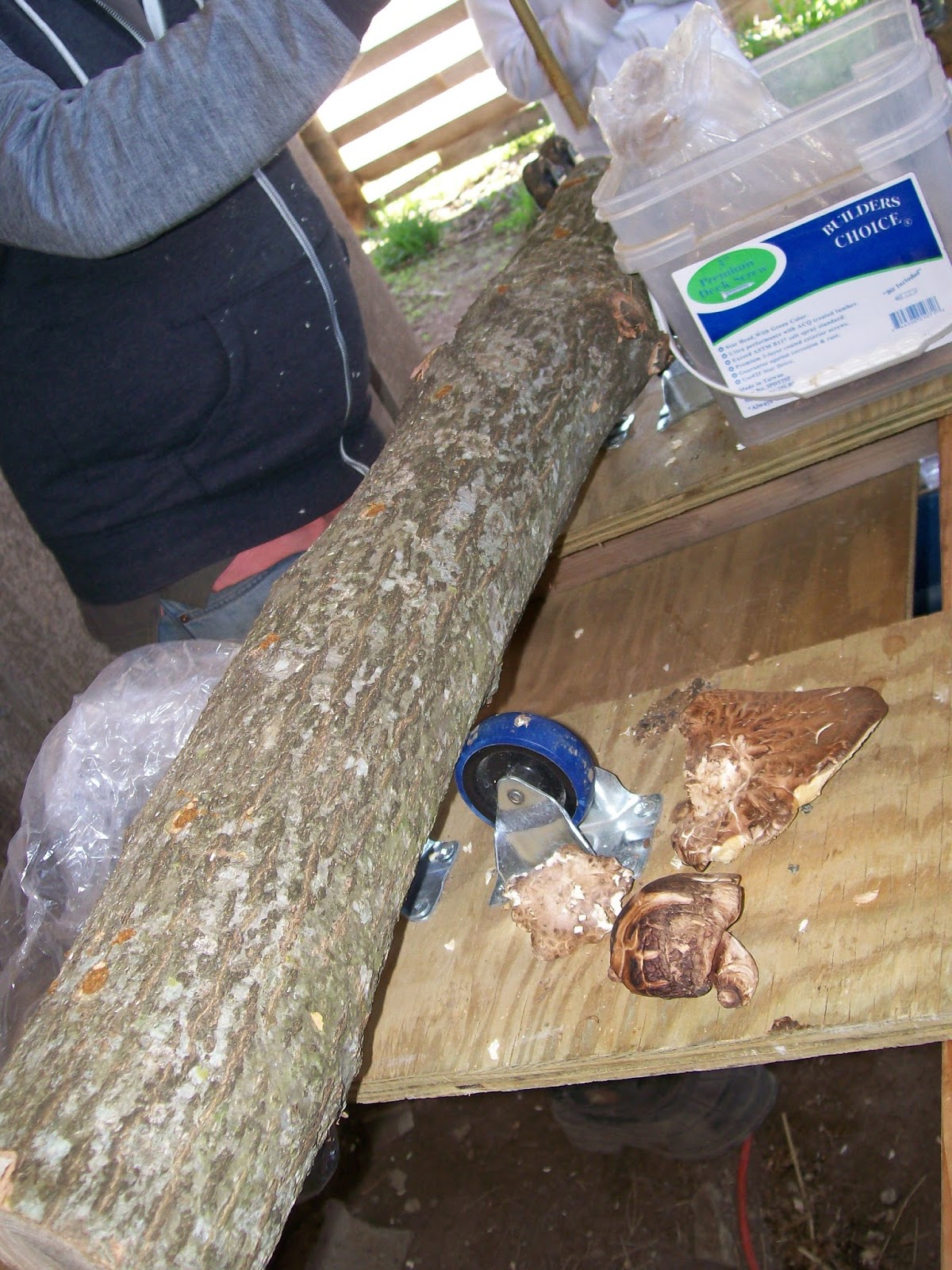
Basically, Shiitake are grown on logs inoculated with purchased mushroom spawn (drill, fill, plug with wax) and set logs (oak is best) in a laying yard will produce in about a year.

Oyster mushrooms grow on totems.  Specific timing and types of wood are essential.  Inoculate shaded logs with purchased mushroom spawn between log sections, cover with plastic bag for about 3 months.  Do not let logs dry out and mushrooms could appear as soon as a few months later and will produce for many years on the same totem.

Winecap mushrooms grow on straw/woodchip beds.  Semi-shade 5'x10' area cleared of leaves and vegetation is layered with soaked straw/woodchips then sprinkled with purchased sawdust spawn, repeat layers, cover with clear plastic.  After 2 months, uncover and mushrooms should appear within several weeks.

Additional Resources:

PSU Extension
Farming the Woods
Fungi

Gregory, Education & Outreach Coordinator, says the short drill is important when you are doing more than 10 logs as it is much faster.

Gregory shows the inoculant tool and the bag of Shiitake mushroom spawn.

Hot food-grade wax is used to plug the holes so the spawn can grown throughout the log.  Mushrooms will pop up through the holes pushing out the wax plug.

Gregory shows that a cattle water tank works well for soaking the logs.

Gregory shows a newly constructed Winecap mushroom bed.

Totems are used for growing the Oyster mushroom.  
They will pop out all around the cut log sections.

Pine Straw Production

There is a huge market for mulch as more and more people realize the benefits of conserving water and weed control in landscaping.  Why pine straw?  It is more cost effective than wood chips as well as in retaining moisture and suppressing weeds.  It does not require replenishing as often as other mulches and is attractive on the landscape.  It creates a more favorable soil nutrient balance than wood chips with minimal effect in altering soil pH.

Each year a pine tree sheds its old needles and if the needles are of sufficient length and quality, they can be harvested and sold as pine straw in bales.  Of the pines available for a pine straw industry in the Midwest, a pitch pine (P.rigida) x loblolly pine (P.taeda) hybrid is probably one of the best.  First harvest of pine straw will occur when the tree is 7-8 years old.

Additional Information:  Pine Straw Advice

Gene, Senior Outreach Specialist, talks about his successes and problems in the Pitch Loblolly Pine area that has a 60'-90' alleyway in between that can be used for growing other crops such as pumpkins or used for grazing livestock on warm-season grasses.  People are sitting on the small bales of pine straw and there's a pile of pine straw inside the circle everyone is around.

Pitch Loblolly tree with pine straw piled around.  
Mature trees can get 40' in height producing much mulch.


Establishment of Warm-Season Grasses and Pollinator Habitat

Fescue is a cool season grass.  Native grass is better than fescue because it is not as thick and is more compatible for small wildlife such as quail. Wildflowers for nectar used by insects need more cleared areas to seed out as we want to promote bees and monarch butterflies.  Jody from the Missouri Department of Conservation presented good information about the promotion of native grasses and wildflowers for pollinators and quail to thrive.  She showed the life cycle of the monarch and what we can do to ensure they continue.  Jody works closely with our Master Naturalist group and we work closely with the Missouri Prairie Foundation and Missouri Monarch Butterfly Pollinator Habitat Restoration Project.

"Prescribed fire is the process of applying a controlled fire to a predetermined area to meet certain goals and objectives."  Prescribed burning is a tool used by a qualified person to manage natural communities and planted grass/wildflower stands.  It can control woody invasion, improve wildlife habitat by stimulating desirable and suppressing undesirable plant species, improve poor grazing distribution, and reduce wildfire risk.  It can also be used to prepare sites for planting or seeding, remove slash or debris, and enhancing seed production of target plant species.

For additional information on prescribed burning, contact your local USDA Service Center or Missouri Department of Conservation office.  Ask for Prescribed Burning - Conservation Practice Information Sheet (IS-MO338).

It was then time for the class to participate in a prescribed burning with Dusty, the Director of Natural Resources Management, Office of Research and Extension, CAFNR (MU)...

Dusty checks for wind, humidity, and temperature just before he sets the fire.
Ready - Set - Burn!

People spreading out as does the fire.

Some areas can burn faster than others.

Sometimes the wind changes and you have to be ready!

Getting close to the electric power lines...but okay, this time.

It can move very quickly...

...so the water tank truck follows close enough.

Several people used water tanks to keep the edges from burning.

At the edge, a yellow rocket (mustard family) lives on!

Timber Management

Dusty Walters, PhD took us out into the deep woods.  His presentation was done as we all stood around enjoying the woodland all around us.  He talked about timber management from the viewpoint that it's your land and only you know what you value.  When you know what you have, you can then know the value of what you have.  Regeneration was the key to management and diversity gives the forest the ability to adapt to changes.  He talked about selling timber and working with a professional forester.  Some helpful publications from the University of Missouri Extension 
would include Publications:

G5051 Selling Timber: What the Landowner Needs to Know
G5055 Determining Timber Cost Basis
G5056 Managing Your Timber Sale Tax
G5057 Basic Elements of a Timber Sale Contract
G5999 Forestry Assistance for Landowners

Another good source of information is the Missouri Department of Conservation's Publication "Timber Stand Improvement - A guide for improving your woodlot by cutting firewood."

Dusty loads everyone up to take us into the woods.

A wonderful classroom to talk about trees!

Woodland Grazing/Silvopasture

"Silvopasture is the intentional integration of trees, livestock, and forage into a managed system to yield production and environmental benefits.  It has great potential throughout the central hardwood region and in the Southern pine region.  Because the practice requires simultaneous production of forest products, high quality forage and livestock on the same parcel of land, intensive management is required."  The benefits of Silvopasture includes reduced animal stress with improved health and calving success.  There's increased feeding efficiency with superior weight gain.  Noticeable improved tree performance can be seen in its health, vigor, height, and diameter.  There is improved financial performance over pure forestry or pure livestock management.

Additional information is available:

Center for Agroforestry, University of Missouri
Cornell University
Silvopasture

Marketing Specialty Forest Products

No one has ever made any money growing specialty forest products (SFPs).  They make money selling them.  Producing SFPs can be a profitable enterprise but the producers must thoroughly understand the unique nature of niche markets before they make production investments.  Producers are required to spend much more time and energy in marketing than is needed for traditional "commodity" row crops.  Producers cannot expect to control the market although a few do such as cedar oil.

There are generally four categories of SFPs:  medicinals and botanicals, forest-based food products, woody decorative florals, and handicraft products and specialty woods.

There are four types of SFPs:

1.  Edible - nuts, berries, fruits, mushrooms, syrups, herbs, roots, ramps, fiddlehead ferns, etc.
2.  Medicinal - ginseng, goldenseal, black cohosh, stoneroot, etc.
3.  Decorative - dogwood, willow, wildflowers, ferns, vines, etc
4.  Handicraft - vines, burls, dogwood, ferns, mosses, cedar, etc.

There are some strategies for marketing Specialty Forest Products:

1.  Know your customer - "Heavy users often make up 20% of the population of users, but consume 80% of the product."
2.  Identify your marketing options - Sell direct to consumer, retail, wholesale, and/or via distributers. 
3.  Develop niche products with multiple markets - Only one market increases your risk as a producer because if that market fails to materialize at harvest, you have limited options to move product.
4.  Secure markets ahead of time - "Be a price maker, not a price taker."
5.  Thinking small can pay off big - "if you compete with the big boys, you must find areas where you will always win."
6.  Setting prices - "Don't underprice your products or your time!"

Additional sources for information:
Agroforestry and Specialty Forest Product Marketing Information
Fruits and Vegetables: A Niche Market for Small Farmers

Some of the successes of Agroforestry in Action in Missouri are growing Chinese chestnuts, propagating pecan and black walnuts, and growing and marketing elderberries.  Check out the 10th Annual Missouri Chestnut Roast event Saturday, October 8, 2016 less than 10 miles north of I-70, off Hwy 5.  It will feature agricultural crafts and products!  It is in the heart of Missouri wine country.  There is also the annual Walnut Festival early in October at Stockton, Missouri featuring Hammons Products.  The demand for elderberry wine is increasing driven by increased consumer interest in personal health.

It is my hope that young people can have a more complete vision of living off the land and not have to settle for anything less than they deserve by becoming more informed and learning from the experiences of those that came before.  There is so much more information available now than when my husband and I "Mother Earthed"or hobby farmed back in the 1970's & 1980's.  If I could take one thing away from this day of learning and sharing, I would say that I may think very seriously about putting in a beehive in my backyard.  We did it before on the 50 acres and now I think we could do it better.  The honey is amazing!

Our final presentation was from Leo Sharashkin, PhD.  He and his family are from Russia and he presented "A Vision and Practice of Natural Apiculture."  I was so impressed, I bought one of his books, Keeping Bees with a Smile by Fedor Lazutin, one of Russia's foremost natural beekeepers.  It was translated by Mark Pettus, PhD and edited by Leonid Sharashkin, PhD.  Deep Snow Press, Ithaca, New York.  The book describes a beekeeping system based on a trust of a bee colony as a living being capable of solving life's challenges without human assistance.  It is for independent-minded beekeepers who are seeking ways to keep bees without treating them with chemicals, disrupting their homes, and otherwise intruding on their lives.

I may write another whole article when I know more and read the book.  For now I will share Leo's website and enjoy the amazing honey I bought from him ($20 for 8 ounces and worth every penny!)
Horizontal Hive

Outdoor classroom with Leo about natural beekeeping.

Leo talks about obtaining bees easily from tree hives then transferring them into horizontal hives.


Monday, April 4, 2016

The Joy of Real Estate Appraisal is Dead

2011 - Day of Retirement in my Home Office
I feel like I should be in mourning.  I am in my 5th year of retirement after 30 years as a real estate appraiser.  Some people go through a low period after only a couple years of retirement and go back to work.  Not me.  I have decided not to renew my General Certification Real Estate Appraisal license when it comes due June 2016.  I will not use the option to suspend it either as I am that sure I'm done with the career and real estate education I began in 1981. The cost to suspend is not much less than just staying in the game.  I have been burning thousands of appraisal and sales files regularly and it feels so good!  I was lucky to have been an appraiser in a time when it was a real joy and I had a highly successful and satisfying career!  It is time to let go.  Still I am a little sad.

I began my appraisal career retirement from the State of Missouri December 2011.  I left my options open just in case my head was not clear from all the negativity in the previous two years before I resigned.  I have written about that negativity in an earlier article in this blog The Joy of Real Estate Appraisal.  Since then, I tried to stay involved to the point of keeping my education and license current but accepted no work.  I regularly visited appraisal sites to be aware of the issues of importance to current active appraisers and was kept informed of any changes in the industry by appraisal organizations.  I remain disconnected to the State Tax Commission (STC) other than the generous pension and health benefits I earned from my 30 year career.  I no longer have the slightest desire to work as a real estate appraiser and my interest in property values has diminished more and more each year.  I will always have my education and understanding of value.  I have grown in many new areas of interest as can be seen throughout this blog.  Now I am free to remember the good times.  The decision to not keep up the requirements for certification was the hardest to make as I worked very hard to get it in the first place.  The recent changes in the appraisal industry, in my opinion, have become more complicated and not in a positive way.  Time to move on.

There were mostly good times and some sad ones!  Remembering helps me get through the reality that those good times have passed.  Writing them down is therapeutic and is something I can come back and read over and over.  I think I will just highlight the years for now and use it as a guide should I want to expand on the memories in the future.  I am thankful that I kept detailed journals of work-related activities for all those years.  I think this may be an appropriate time to retire the Blog Label "Real Estate Issues" and continue in "Personal and Spiritual Growth" after this post.

1981-1984  Hickory County Assessor Office  - Who knew that answering an ad in the local newspaper for temporary part-time work as a data collector could lead to a full-time position learning all the aspects of re-assessment and being chosen by the assessor to eventually replace him?  All that and being close to home, my husband's workplace, and my children's K-12 school was more than I ever expected from such a small rural county we chose to move to in 1978.  I would have been satisfied.  The opportunity to work for the state doing much less work for twice the pay with benefits came knocking.  My husband gave me his full support.  It was brave of me to give up what I knew to be secure and safe for the unknown.  The motivation was that I would have a home office with time flexibility in raising my children, good health insurance, and pension benefits.  The travel would be about two weeks out of 6-8 weeks.

1984-1990  Establishing my Credibility - The first year I stayed away from home about 50 days for schooling and some of my territory was too far to drive home every night. That was the most difficult thing I ever had to do and almost gave up because it was hard on my family with young children.  When I made it known that I had to be home every night or I would have to quit, my position changed to be away much less often and always close enough to drive home with maximum expenses.  I went from basically a residential appraiser to a commercial appraiser position.  My education continued and my experiences grew as I worked in 25 different counties.  I was establishing my credibility as more and more market data became available.  I grew in so many ways!

1991-1999  The Best of Times - With my credibility established and my property values rarely challenged, it was a time for personal growth in my private life.  The job was routine for the most part.  I found it fun and challenging as the first one on staff to be trained in computers, programs, and digital cameras before it was required of all the staff.  While I was at my home office for 4-6 weeks, I was very active with my children in school activities, scouting, church, family time, and developing my hobbies.  My husband's job at the garment factory was insecure so he began night school to better his skills for more secure employment.  There were many deaths in the immediate family so family connections were very close.  It was a good time for my job to be secure and relatively routine, easy, and predictable.  When I had to go out and collect data for two weeks, I was happy to have a change of routine and location to meet interesting and sometimes powerful people in the banking and real estate business.  I had wonderful challenges in the variety of properties to value.  It was exciting!  Then I was ready to be home again all day for 4-6 weeks in my home office and then it began again.  Always something new and never boring!

2000-2005  Nothing Ever Stays the Same - As soon as my supervisors realized my children were grown and out of the house on their own, I was given some challenging break-out assignments that kept me away from home more and more.  It began with assignments in the southeast corner of the state along the Mississippi River.  Then larger cities such as Joplin and Springfield appraisals which gave me experiences that helped me become a General Certified Appraiser.   I had unique experiences from commercial recreational areas around the many Missouri lakes and the Branson entertainment market.

With my husband's work situation changing, I decided to go back to school and take all the courses needed to become a certified appraiser as state jobs took a turn with talk of staff reductions and expenses reduced.  I thought I should increase my job skills and contacts to be able to work in the private sector should the need arise.  I was successful but it was much harder than I originally thought because my training and skills from the state were not typically transferable because they were more specific to larger market areas.  It was a different path that far exceeded the path taken by the average appraiser.  It was a transition period for the appraisal industry that was progressing to certify appraisers both in the public and private sectors.  It was difficult to regulate appraisers when one employer serves the public and one employer serves profit.  I was the first in our group that managed to make it through the National Uniform Standards Profession of Appraisal Practices (USPAP) accreditation. The Missouri Appraisal Commission, who provides the state appraisal licenses, had recently been given national credibility after about 10 years of formative progress in Missouri.  It appeared that not only was I being scrutinized personally, but also the STC, the leading final authority on property values for the public.  It was the state licensing agency vs the state taxing authority.  I was a winner and I had done it all by myself without the help of the STC although they did reimburse my expenses afterward and verbally supported my efforts.  Big changes in the appraisal industry were happening both in the public and private sector.

Elizabeth A. Pearson, Manager Ratio Study Section of the State Tax Commission of Missouri


2005-2007  Manager of the State Tax Commission of Missouri -  I was the most current General Certified Appraiser on our staff as of 2005.  A couple other staff members had the certification but attained it during the early years of the licensing agency before they were very credible and people were mostly "grand-fathered" into the certification.  This was before the more extensive experience and educational requirements were finally established in compliance with USPAP.  When I learned that the manager of the STC was retiring after 27 years and the assistant manager was also retiring, I applied after giving it thought for two weeks talking it over with my husband.  I had never considered it before and never had it as a goal.  But my intuition told me that I could best influence statewide property values and do right by USPAP in the position of manager where I could actually change policies and procedures.

I got the position!  For the second time in my life, my salary nearly doubled and my physical work load reduced!  There was much more stress but much satisfaction as I was in a position to implement all that I had learned to make the department more transparent and efficient in compliance with USPAP.  I had told the commissioners that I would accomplish all that I wanted in three years; I did it all in 18 months!   As manager, I was required to live in Jefferson City, the state capital where I worked.  I rented a duplex condo and bought all new furniture that I planned to move back to the Hermitage home later.  I drove back to Hermitage on weekends.  My office at the Truman Building was on the 8th floor and had a picture window wall overlooking the Missouri River and the State Capital Building across the street.  I had a staff of 30 in the field and use of office secretaries and a Statistician.  I only had 2-3 STC Commissioners appointed by the Governor to answer too.  I was in the best position on staff to implement the audit changes required by then State Auditor, Claire McCaskill.  Legislature was changing and the STC's purpose was redefined.  It was up to me to bring the STC more transparency to the public in compliance with USPAP and provide policies and procedures for all 114 counties and the City of St. Louis in updating their property values.   My first project was to produce three extensive reports - how we got to where we are since re-assessment began in 1978, where we are now and what we are doing, and recommend changes through policies and procedures.  All of which was approved through the International Association of Appraisal Organization (IAAO) which was headquartered in Kansas City, Missouri.  I worked extensively with them and helped establish new ratio study codes which are used nationwide.  It was the most exciting time!

After 18 months, the newness and excitement wore down as my health issues were affected by the added stress.  I had done all that I had wanted to do in half the time I said I would. My intuition was telling me that the Commissioners wanted a manager that would "tell them what they wanted to hear" instead of my "tell it like it is." Politics began to take over after all the changes I made were working.  The only thing lacking was the follow-thru process where final tweaking and changes may be needed that could only be identified as it happened.  It was very easy for a new manager to step in; much easier than it was for me with the mess I found when I began!  While the staff was out implementing all the changes in the field, I sat in the STC office and waited for the appraisals to come to me for finalization.  It was all working well enough and I was proud of all that I had done.  I wanted to go back to what I liked best which was field appraising and a home office.  I negotiated my salary to the highest level on field staff which I never would have gotten had I not taken the manager position due to salary freezes.  It was a hard decision resigning the manager position at the peak of my career!

2008-2011  Pre-Retirement - The transition from manager back to field appraiser was easy.  Even with some surgery and extended sick leave, I was called frequently and had to appear in person for important meetings during the transition.  It took a long time for another manager to take my place.  When it was filled, it was with the local county assessor who had just been elected and choose to leave his office mid-term which pretty much killed him politically.   He was under more political pressure to do as he was told by the Commissioners.  I think that may be why he disliked me and made the final two years of my time not so pleasant.  He changed as much as he could of my policies and procedures to make them his own and get credit.  I didn't care so much as his arrogance finally done him in and he was gone a short time later.  The female that I had recommended for the position when I left finally got the manager position and is still there as far as I know.  I can only smile as I got all that I could ever want by doing the best I could leaving the STC better than I found it.

It is all dead to me now.  I will remember the joy of real estate appraising as it was and what I made of it for my life and all those that I have affected.  It was a good life as an appraiser.  It was a good career.  It was what I did and not who I am.  It was the means to a golden retirement.  I will stop being sad one day past my appraisal certification renewal deadline!


Monday, January 4, 2016

High Tea, Downton Abbey Style


The beginning of 2016 also meant the start of the final season of the PBS Masterpiece Theater showing of Downton Abbey.  One of my Master Naturalist friends had recently been to England to visit Highclere Castle and had many wonderful photos and experiences to share.  A most appropriate way to do that was to host a high tea on the day of the first episode of the final season.  There was the option to dress-up in the styles of the 1920's.  Of course, all the guests were big fans of the show and it was fun to be part of that group of ladies, play dress-up, and have a "big girl" tea party!

The first thing to do was to get a hairstyle.  That was easy enough online as there were many how-to videos to choose from.  I choose the simplest finger wave bob.  I had practiced a couple days before and it was easy enough to get the look I wanted a few hours before the event.  I can understand the need for an "Anna" to fix the back as I just put in some waves and let it go at that!  The makeup was simple too as it was mostly about the "big eyes" and "Clara Bow" lips.


The dress I had was an old alfred angelo gown from my daughter's first wedding that needed re-purposed.  I added a few changes like the creme-colored top, lace gloves, pearl necklace and flat black shoes and hose.  The hostess of the tea party had a very lovely outfit she got in England.  There were many different hats and gloves provided by the hostess for all her guests, if wanted.  There was even a few gowns set out to borrow.


There were about a dozen ladies show up and here are the early guests.


The hostess set a beautiful table with cake, scones, tea sandwiches, nuts, candy, jam, and lemon curd.


Many of the tasty foods were recipes from England.


Of course there were many pots of hot water for tea!

Lots of interesting stories to share...


...from people of many experiences and travels...


                                                                               ...and more tea...


                                    ...and an author who wrote a book about her travels on Route 66!


I met new people and even made a new friend or two.


What a great way to start out the new year doing something new and different with interesting people!  I'm happy I came even though it seemed a little silly at first to have a dress-up tea party as an adult.  But it was nice and I'm glad I talked myself into it.  As the first episode of Downton Abbey began, I know this last season was one to be most remembered!


Friday, January 1, 2016

Hoppin' John for New Year's Day


"Eat poor that day, eat rich the rest of the year. Rice for riches and peas for peace."
Southern saying on eating a dish of Hoppin' John on New Year's Day.
 

We have had Hoppin' John  every New Year's Day since we moved to Missouri in 1978.  We have prospered in Missouri and have no regrets.  Some say I'm just full of beans.  Well, it takes a special kind of bean, I say!

"History of Hoppin John: Hoppin' John is found in most states of the South, but it is mainly associated with the Carolinas. Gullah or Low Country cuisine reflects the cooking of the Carolinas, especially the Sea islands (a cluster of islands stretching along the coats of south Carolina and northern Georgia). Black-eyed peas, also called cow peas, are thought to have been introduced to America by African slaves who worked the rice plantations. Hoppin' John is a rich bean dish made of black-eyed peas simmered with spicy sausages, ham hocks, or fat pork, and rice.
There are many variations to traditional Hoppin' John. Some cook the black-eyed peas and rice in one pot, while others insist on simmering them separately. Some also like to add the collard greens in the pot. The favorite way to eat a Hoppin’ John meal is with collard greens and corn bread. Each item on the plate has symbolic meaning for the New Year. Black-eyed Peas represent “coins,” collard greens represent money or “green backs”, corn bread represents “gold,” and if tomatoes are added to Hoppin’ John it symbolizes "health".
It was the custom for children to gather in the dining room as the dish was brought forth and hop around the table before sitting down to eat.
A man named John came "a-hoppin" when his wife took the dish from the stove.
An obscure South Carolina custom was inviting a guest to eat by saying, "Hop in, John"
The dish goes back at least as far as 1841, when, according to tradition, it was hawked in the streets of Charleston, South Carolina by a crippled black man who was know as Hoppin' John.

Southern Superstitions about Hoppin' John:
This African-American dish is traditionally a high point of New Year's Day, when a shiny dime is often buried among the black-eyed peas before serving.
Whoever gets the coin in his or her portion is assured good luck throughout the year. For maximum good luck in the new year, the first thing that should be eaten on New year's Day is Hoppin' John. At the stroke of midnight on New Year's Eve, many southern families toast each other with Champagne and a bowl of Hoppin' John. If it is served with collard greens you might, or might not, get rich during the coming year.
If you eat leftover Hoppin' John the day after New Year's Day, then the name changes to Skippin' Jenny since one is demonstrating their determination of frugality. Eating a bowl of Skippin' Jenny is believed to even better your chances for a prosperous New Year!" 
Source: Beyond Black-Eyed Pease: New Year's good-luck foods, by Mick Bann, Dec. 26,2008, Austin Chonicle.

"There is also another tradition in some parts of the South that you should count the number of peas in your serving to predict the amount of luck or wealth you will have for the coming year. If you leave three (3) peas on your plate when you are finished eating, then you New Year ahead will be filled with luck, good fortune, and romance."
Source: Wikipedia - Hoppin' John.


For 2016, I believe I have made the best dish so far and want to share my recipe:

Beti's Hoppin' John

Ingredients:
2 cups cooked black-eyed peas
2 cups cooked rice
2 cups broth, approximately
1 red onion, chopped
1 pound bacon, cut into small pieces
1 pound sausage
hot sauce and red pepper flakes, to taste

1. Cook the bacon pieces until crisp, remove from pan onto paper towels to drain fat.  Leave most fat in pan.

2.  Cook sausage in the bacon fat until brown, then add chopped onion.  Cover and cook on low without stirring for 10 minutes.  

3.  Completely drain away all fat.  Keep sausage and onion in pan.

4.  Add rice and black-eyed peas; thoroughly mix.

5.  Add broth to desired consistency.  Season with hot sauce and red pepper flakes.  Simmer for 30 minutes.

6.  Stir in bacon pieces just before serving.

Traditionally served with cornbread and cooked greens.  The type of ingredients and sides may vary.  Here are what I have found to be the best:

Black-eyed peas from cans, drained and rinsed.
Wild, black rice and Spanish rice; half and half mix.
Broth is from a smoked turkey we cooked at Christmas.
Bacon is low-sodium.
Sausage is Jimmy Dean's Natural.

Sides are whatever I have leftover and bread is whatever is on hand or I will make some fresh cornbread.  That is part of the frugality.  This dish is good using any version of the main ingredients of rice, black-eyed peas, and pork which most southerners always have on hand. How you put it together makes it your own.  Just like your prosperity...it is what you make it.

Enjoy and have a prosperous New Year!


Wednesday, December 30, 2015

Financial Planning - Beginning my 5th Year of Retirement

I have ended my 4th year of retirement in a good way.  The decision to begin Social Security at age 62 was made and it will work very well for me.  An added bonus is that is will also work very well for my husband.

From my last blog about Financial Planning, I was undecided about starting Social Security and thought I should try living on my base retirement and profits from my investments until I'm age 66 which is the full benefit age.  I had no significant savings as I have been making large purchases instead.  Here are the reasons that this appears to be the best decision at this time:

1.  The Temporary Payment portion of my state pension ends when I reach age 62 with the assumption that Social Security will take it's place.  This payment was about 1/3 of my total pension.  Social Security is a couple hundred dollars more per month than that Temporary Payment.

2.  The marital strategy of "file and suspend" would not benefit me but would be much less in dollars and runs the risk of less payment should I become a widow before my husband reaches age 70.  This "file and suspend" strategy will be discontinued by March 2016 as it was found to be a legal loophole by politicians that was recently negotiated to close.  I think it worked best for those couples that had one spouse with very little work history that paid into the system.  I have 40 years paying good wages into the system and now it is payback time!  Remember the TV horse show from the 1960's, "My Friend Flicka?"   Well, now it's My Friend FICA!  Thanks to all you wage-earners out there!

3.  Instead of "file and suspend" we were told by a Social Security Representative that it would be to our benefit for me to file at my earliest time (my 62nd birthday) and then have my husband file on me while he continues to work until age 70, the maximum payment age.  This does not affect my amount in any way but gives my husband half of what he would be making at age 66.  We had thought it would be half of my age 62 amount but it turned out to be half of HIS amount at age 66.  The law had changed in recent years that allows a person to make a larger amount of wage and still collect Social Security.  Of course, there will be taxes paid on this higher income for my husband.  Best of all, his Social Security continues to grow to maximum and I can collect off his increased benefits should I become a widow.  Win-win situation!

4.  The money my husband unexpectedly will now be making off my age 62  Social Security filing has been earmarked for home improvement which will take any pressure off his wages (he's still saving for his retirement) and I likely will increase my savings for added security.

5.  My investment base amount has dropped in 2015.  I had expected a minimum of 6% growth each year and got in the first two years.  The past two years have been less than 6% and 2016 will be the first year I will not take any distribution.  The distribution was used to largely fund my Health Savings Account (HSA) each year.  That amount is the maximum out-of-pocket dollar amount I have to pay for my medical issues.  I will try to pay that amount in 2016 from my savings; if not, I will have to reduce the base amount of my investments.  I don't want to do that as I've stopped adding to it when I retired.

For the most part, I have been living within my means and enjoying my retirement with little restrictions.  My needs and expectations are less than when I was working and I'm traveling about as much as I want.  I still have a dream to go to Europe and may be getting closer to a real time as now I have decided I do not want to travel alone and may wait for my husband to retire since there appears to be no one else available in my life that wants to or is able to travel with me.  Maybe a few years of savings will make it all real and my husband and I will have the trip of our lifetime!

It still takes some planned effort to make sure I'm secure enough and manage any financial stress potentials.  I have recently been relieved from a 2% income tax loan that I finally paid off from 2011 as I had a very large backdrop payment when I retired from the state.  Half of that paid off bills and bought a new car for cash and the other half is my investment base.  I still kept a balance on a 9% credit card that did not get paid down every month these past two years.  I have recently put that amount in a 0% Credit Union credit account that I will pay off in 18 months.  Again, that increase savings potential from the new Social Security situation along with continuing with the normal payment I am use to paying for that 2011 income tax loan will take care of that as long as I keep the discipline and not add any more credit debt.

Because of the uncertainty of when my last Temporary Payment will be made and when the Social Security payment begins, I have been living lean so as to not spend money I don't have until I get it.  Christmas was leaner than usual.  I did spend more than expected on homemade gifts which for the most part was the final genealogy product I've been working on extensively this past year.  I made nine copies for family members and that cost.  It is also the final product.

So I'm starting out the new year with some uncertainty waiting to see my new reality.  Expected increases from Social Security and commitment to save more money so I can do more is the main plan.  My husband will take care of the household repairs and remodeling and my financial help will not be expected now.  My health expenses are big and won't change until I'm 65 when Medicare takes some of the load.  Best I can do is to manage my health issues as to keep my good quality of life and make sure the money is in the HSA when I need it.  Financing my activities is manageable as I have found a level of activity that is comfortable and do not want to increase.  As you can see by my other articles in this blog, I'm active enough!  I do plan to travel to see family out of state a couple times a year and 2016 will include a trip to the west coast for the first time.  There is much to look forward too and I can reasonably expect success.

The Beginning of My 5th Year of Retirement is optimistic!  My health issues have progressed but there are new medicines recently prescribed that are working good!  My prosperity is good as long as I keep within boundaries I have set with a realistic budget.  I am getting much better at it since I have retired than when I was working!  My happiness comes from being at peace with myself and improved relationships with my family and friends.

I have real expectations now that I own my own time and don't allow anyone to stress me out or waste my precious retirement time.  I am in a position to let everyone know how much they mean to me and that I value their time.  I am able to love unconditionally.  I let people know I can be there for them and am flexible to their time if they're still working.  But I can find many interests on my own when they are too busy to include me in their lives.  True happiness comes from within and not dependent on other people.  I am still challenged to find a balance between caring about people that may not care about me and being true to myself.  I do have more "true" friends now than when I was working.  Life's experiences have taught me that many relationships are conditional and self-serving.  Retirement has shown me that there are many people that truly value me and like having me around just because I am me.  Intuition has given me the power to see the difference!


Wednesday, December 23, 2015

Time for Family, Friends, and Genealogy

I made 9 copies of 3 branches of our family tree which included 7-8 generations beginning in the 1830's with help from Family Tree Maker, Ancestry.com, and living relatives.

It has been a wonderful year filled with family and friends!  It also was the end of a year-long genealogy project I wanted to share with immediate family members for Christmas.  I feel so blessed to connect with the past and present and look forward to many more years of family growth and discovery.

I was so pleased to learn from my daughter that she helped to organize a family get together with relatives in Iowa and Nebraska for Thanksgiving week.  It would be a great time for family members to meet her new husband as well as reconnect after many years!  It took several days to fit every one's schedules but we got it done and memories were made.  My son and daughter-in-law traveled all the way from Virginia!  It was too bad that my husband could not be there due to work commitments.


It began with Grandma's Day.  There was a pizza and wings party and my children and their spouses spent quality time with my husband's mother and two sisters.


After our visit with Grandma and the Aunts went back to work, my children and their spouses went with me to see my friends at the courthouse nearby.  I've been blessed to have had these beautiful ladies as my friends since the early 1970's.  One was my Maid-of-Honor and the other my senior classmate and neighbor.  We have kept in touch all these years.


The next day was spent with 14 family members at a restaurant in Omaha.    Good food and lots and lots of conversation.  My brother and I were so happy to see our combined families together in one place!  Missed very much were my husband, and two of my brother's grandchildren and their families; otherwise, that would make 8 more members for a total of 22 between us two siblings!  Now if our other brother from Virginia were here with his family that would add 14.5 more for a total of 36.5 family members between two brothers and a sister!


The next day was spent at my brother's house and I made plans to spend the afternoon with my dear friend who lives nearby.  She was the first friend I made when I first moved to Iowa in 1971.  We were also senior classmates.  It was her first day of retirement and I helped her celebrate!


Then came Thanksgiving Day!  My daughter and her husband had to travel back to Missouri for work commitments the day before.  My son and daughter-in-law spent the day with her cousin and their family in Omaha.  So I was fortunate to have a big family dinner at my niece's home in Omaha.  So much good food prepared by great cooks and everybody helped out.


While we were eating inside...the rain was freezing outside!


The next morning there was a thick coating of ice on everything so I waited until my car thawed out in my brother's heated garage before attempting the icy 6-hour drive back to Missouri!

I got home safely from Iowa that evening although the drive by myself was very stressful.  A couple hours later, we were fortunate to have my son and daughter-in-law stop by our home in Missouri for dinner on their drive back to Virginia.  My husband was especially appreciative since he missed this family trip with me. 


With the Thanksgiving festivities over, it soon moved toward the birthday and Christmas season.  My son had his birthday and was given his gifts from me before he went home.  A few days later, my good friend and I celebrated our close birthdays together with a trip to Branson.  We saw a show, the Christmas lights trail, and had a nice dinner at Olive Garden.


My husband surprised me with a dozen red roses, my favorite chocolates, and a lovely card for my birthday!  


We had friends, a husband and wife who live nearby, over to our house for my traditional kolache and coffee.  


Then I was invited to a friend's house for our regular Girl's Night Out and Christmas gift exchange where we also celebrated my birthday with a cake and good company!


The weather had been so unseasonably mild for this time of year here in SW Missouri that my husband and I got one more time to kayak on our local lake.  The sunset was exceptionally beautiful as the lake looked like it was on fire!


It was quite a challenge to put together my Christmas gifts of genealogy binders this year for nine immediate family members.  My computer crashed and was in the shop for a month and I ran out of ink a couple times!  One of the three branches had 17 pages to trim and paste together...for nine copies!  Still I enjoyed every minute and it was all in the mail the Monday before Christmas with hopes that most of them will get there on time.  Family time may not always be easy but it is always worth the effort!  And not to be left out is my Bobi Kitty...my loyal friend and family member wishing everyone a very Merry Christmas and Happy New Year!