Introduction

Introduction: Mapping Out a Plan for the Rest of My Life and Enjoying the Journey

My Golden Years are an extension of the life I have lived up to retirement which began on December 1, 2011. I have organized this blog to include the top ten relevant topics shown below in the right side column in General Topics. Just click on one and you will see all that I have written on that topic. Click on the Most Current tab for chronological order of all entries.

I have addressed each topic in no particular order other than what is currently on my mind on the day I am posting. I started each topic by describing where I was when I began this blog and then exploring the possibilities of progression and any goals that I would like to meet. After that, I write about the path to reach that goal as it happens. Sometimes I just write about what is happening now.

I welcome any comments and questions either on this blog or email as I travel these paths and hope to share my growth with interested persons who may find some common elements in their own path to the rest of their life. I hope to use my skills as an appraiser for nearly 30 years to continue to observe different perspectives on a subject and reconcile into a conclusion that is of value to me. Please join me whenever you like. Email notice of new posts is no longer available so just bookmark the address.

The Blog Archive tool is helpful to find posts by year. Of most importance to me is the confidence developed in my intuitive skills over the years and it is that part of my character I am trusting to define value in my life. I believe change can be good and I can be enriched by believing in my true self using my intuition. The analytical part of my life no longer has a financial grip and I can let go of what absolutely made sense at the time in favor of what feels right now. I have done a lot of work since this blog began in 2011 and I hope you will join me as I explore this approach in My Golden Years.


Pages

Wednesday, May 28, 2014

40th Anniversary Celebration


Our favorite place 40 years ago was where we were married - Preparation Canyon State Park near Moorehead, Iowa.  The outdoor wedding was appropriate to our lifestyle which included true love that could be found in a natural, uncomplicated environment surrounded by like-minded people who came together to celebrate our union.   It is no wonder that Keith and I would grow together and find another place that complimented our common interests as we celebrated our 40th Anniversary.


It all began at Preparation Canyon State Park...

Beti & Keith married May 11, 1974

The Arlington Hotel in Hot Springs, Arkansas

We first discovered Hot Springs as a family back in 1992 when we took our two children on an adventure to hunt for diamonds at the Crater of Diamonds State Park near Murfeesburo, Arkansas.  On our way back to Missouri, we stopped at The Arlington Hotel as we were in need of a nice bath after mudding around looking for diamonds.  We didn't find any diamonds.  What we found was more than just a bath.  We discovered what is known as the "taking of the waters." This had such an impact on Keith and I that we returned years later for health reasons and continue to make the trip a part of our lives for about the past nine years.  We hope to return each year and make this our favorite vacation spot.  There are many things to see and do and each time we come, we find something new.  Hot Springs National Park is just across the street.  It is our nation's first national park.  Technically, it was called a reservation because the National Park system didn't exist in 1832 when the federal government took the unprecedented step of setting aside four sections of land to protect this natural resource.  Because of claims on the boundaries, it wasn't settled until 1877.  So it was first a reservation and then by 1921, the new National Park first director, Stephen Mather, convinced Congress to declare the reservation the 18th national park.  The eight bathhouses were already there and very popular.  The Army-Navy Hospital was built in 1933 and is now a rehab facility.


Beti at the hot water fountain outside the Fordice Bathhouse on Bathhouse Row.  The Arlington Hotel is the multistory building at the beginning of Bathhouse Row which has magnolia trees all along Central Avenue on one side and unique shops on the other side for several blocks.  The National Park is located to the rear of the bath houses and has several levels going up the mountain.  The hot water comes out of the ground in several places freely and is capped and channeled for use in about 47 places.  


The Magnolia Trees line Central Avenue and were just beginning to bloom the second week of May.  They are in full bloom by mid-June.  The scent is intoxicatingly wonderful as the warm breezes carry throughout the area!


Open hot water spring pools at the base in the landscaped park just across from The Arlington Hotel.


View of the open hot water spring pool from the first level walkway above overlooking the  city and The Arlington Hotel.


In recent years, Keith and I would ride around the downtown Hot Springs area in a horse and carriage at night.  It certainly is the best way to experience the lights, smells, and sounds of night life in the city on a Saturday night.  It is one of the services provided at The Arlington Hotel.


Our favorite restaurant nearby is the Belle Arte Ristorante serving good Italian cuisine.

There was a large Farmers Market near the old railroad station in what is now the city park.  It has a large variety of vendors and, of course, we found a plant or two to bring home to add to our garden.  As a special treat, we enjoyed listening to a blues band that played on site.


Another place we have visited several times is the Garvan Woodland Gardens which is a short drive outside the city limits.  There's about four miles of trails that make for a wonderful walk full of a variety of plants and landscapes.  I took so many photos and noted so many new ideas for gardening and landscape inspiration.  What a wonderful way to spend a morning!


Beti and Keith on Millsap Canopy Bridge


Glass Chapel hosts many area weddings.  Reminds me of another outdoor wedding location!


Millsap Bridge over Singing Waters


Bridge of the Full Moon


As a special treat, we drove one day about an hour north to the Little Rock area  to attend the P. Allen Smith Garden Home Tour.  We became familiar with this place from the show P. Allen Smith has on PBS.  It was impressive especially knowing it all started only six years ago.  The tour took all day which included a nice lunch and free time to roam freely anywhere on the estate.  Again, I took many more photos than I could possibly include here!


P. Allen Smith Garden Home on Moss Mountain overlooking the Arkansas River near Little Rock

Beti at a rock wall in the greeting area.

Beti and Keith with the Arkansas River to the rear facing the back of the house.

Beti and Keith with the back of the house to the rear facing the Arkansas River.  

Beti in the kitchen admiring all the Viking appliances and equipment used on the PBS show for the cooking segments.  P. Allen Smith is all about the complete garden home influenced by Thomas Jefferson era concepts with modern conveniences.

One of several cottages around the house is an Art Studio admired by Keith.


Many different pathways connect a variety of "garden rooms" throughout the estate.
On our last full day at Hot Springs, there was a parade on Central Avenue the length of Bathhouse Row.  It was the 9th year of The Running of the Tubs.  That busy Saturday morning, the street was closed off and water balloons and other water-shooting devices could be seen gathering in piles all along the way.  The crowd joined in as the tub-runners made their way to the finish line.  Of course, it was not to be just a race…there were stopping points along the route where the races had to perform all kinds of tasks such as "ring around the tub" where all contestants had to get out and run around the tub or do push-ups, or whatever the judges could think of as the spectators pelted them with water.  It appeared that it was the judges that were the target of many of the water balloons!  All the time, the tubs had to keep 10" of bathwater inside and follow an outrageous number of rules to qualify all in fun.  This year there were eight contestants.

It was a great ending to our wonderful 40th Anniversary Celebration!

The Arlington Hotel - Pac Attack

Batman

The Farmers Market (including a duck and goat)

Fire & Rescue

The Flintstones

Hot Springs Water - Mario Brothers

Police Department SWAT (Special Water Attack Team)

Ninja Turtles


And the winners are…The Arlington Hotel - Pac Attack!!!!

Wednesday, April 9, 2014

Income Approach to Value


So many things in life are a gamble.  You do the best you can with the tools you have at the time.  When you know better, you do better.  When you do better, you keep doing it so you don't lose it.  You let it go when it is no longer of any value to you.  Right now, I'm not sure why I'm still in the appraisal game.

I needed to challenge myself and chose to include a course on the Income Approach to Value as part of my 28 hours needed for Continuing Education for my State Certified General Real Estate Appraiser license which comes due every even year by June 30th.  I just got an 87% on the exam which is good for me after not being active for a few years!  I think that's the highest score I've ever gotten on any income approach course.

This time I am doing all courses online through McKissock.  I like that it is less expensive to do it online and that you don't move forward until you understand the concepts presented which is definitely getting your money's worth.  Physically attending classes costs more - the courses cost more and gas mileage which for me is quite a chunk of money unless I want to stay overnight in a motel which is another expense.  I had taken many of these courses over the years and the best place near me has been with Lowman & Company out of Sedalia, Missouri.

There are a couple advantages to taking courses in person vs online as you only attend for the number of hours you get credit for and you have contacts with peers which is beneficial for busy and actively working appraisers.  You may or may not retain all the concepts because the class moves forward whether you keep up or not.  The online courses generally take longer because of the stop and start aspect and you just take more time because it is at your speed (for me anyway).  Being retired since 12/2011, I'm in no hurry and have been giving it a couple hours 1-2 days a week which is pleasant and I feel confident knowing the material and it is kind of fun the way McKissock presents.

I have taken many courses specifically on the income approach; my first taught by a man named Irv Johnson back in 1984 when I first started working as a Commercial Appraiser for the State of Missouri.  IRV is the basic income approach formula:

Income
Rate x Value

Income = Rate x Value or
Rate = Income / Value or
Value = Income / Rate

And so it begins…you have to know two of the components of the formula to find the third.  That is the basic game plan.  It gets much more complicated and every appraisal has many different ways to find each component and to test it's accuracy.  Experience over many years brings confidence.  It took me about five years to gain that confidence and I used it in my practice for 30 years and have applied it thousands of times.  It is never the same as each component constantly changes and like a slot machine, you have to have the right information compatible with all components at the same time.  When it does come together, it can be challenged almost immediately and usually was in my kind of work monitoring the county Assessors' Offices.  Creating a path to value with defensible documentation and reasoning is important.  Rarely is an appraisal 100% document-able.  As with all three approaches to values, intuition is necessary, and that comes with experience.  In today's world, intuition is not as acceptable as it was and probably rightly so as it was abused and there was much fraud in the industry.  It brought down Savings & Loan Banks in the 1980's and hurt our economy.  The 1990's brought appraisal certification with national Uniform Standards of Professional Appraisal Practice (USPAP) evolving; although the lending institutions grew the fraud by making bad loans which eventually increased to bring down the economy even more by 2008.  I have addressed these issues in earlier blog articles under Real Estate Issues.

A quick review here may help with understanding the process of real estate appraisal.  Start with the Types of Value - business value, disposition value, fair value, going-concern value, goodwill value, insurance value, investment value, liquidation value, market value, use value, and value as is.  As a commercial appraiser, I have to understand and identify all types of value but market value is what I do in my line of work.   The market is where I get all the components needed for the three different approaches to value.  All three approaches are addressed in each appraisal and reconciled to a final value.

The three Approaches to Value are:  Cost Approach, Market Approach, and Income Approach.  The Cost Approach is most defensible for newer constructed properties as cost manuals are very accurate in measuring the building cost value.  It is also good for odd or unique properties.  Marshall & Swift is the most widely accepted cost system in the world.  It is up to the appraiser to measure and report physical aspects correctly.  The variable aspect is depreciation which has more guess-work (intuition); the older the building, the more it is affected by outside forces such as functional and economic issues.  Also, land value has to be validated separately for it's highest and best use.

The Market Approach is most defensible in an active market especially where sales of comparable properties occur frequently enough to measure time factors.  Also, it is not common to find exact
comparable properties so the adjustment figures weigh very heavy on credibility.  Then you need to find at least three or more comparables to do statistical analysis.  This method is what the government-back loan agencies require most frequently such as VA, Fannie Mae and Freddie Mac.  There is very little room for guess-work (intuition) because this area is where the world of bad loans took a dive.  Adjusting comparable sales became an art in itself and massaging figures to make the mortgage loan value the most beneficial in the bank's favor is why USPAP has become such an important compliance tool accepted by everyone in the appraisal field for all types of value.

The Income Approach is most defensible when the income characteristics of a property attract investors.  Homeowners are attracted to houses because of the amenity benefits inherent in ownership; it is driven by emotion.  The typical investor anticipates future benefits that are financial in nature.  Property uses such as retail, office, and warehouse can be rent producers.  2-4 unit properties are typically bought for investment purposes.  The use of a gross rent multiplier would be appropriate.  More than 4-unit complexes would employ a capitalization of net income by a capitalization rate or a discounted cash flow analysis.  General Appraiser Certification is required beyond 4 units.  Leases must be analyzed as well as different kinds of rents - contract, scheduled, market (same concept as Market Value).


HP12c Financial Calculator

There are up to 12 formulas to develop an overall rate used in direct capitalization.  There are several techniques such as band-of-investment which uses a mortgage constant.  There are residual techniques where different rate components are known from building, land, equity, and/or mortgage.  The world's first horizontal financial calculator was first introduced in 1981 known as the HP12c.  This instrument is the most useful tool for the commercial appraiser!  Most courses on the income approach require at least basic skills with the HP12c.  Most of the courses are exercises in solving financial problems to develop a final value.  To solve a problem, you need to know any 3 items - then solve for the 4th unknown item.  Some problems you need 4 items to solve for the 5th.  The information can be added into the 5 keys in any order.  Those basic 5 components are: present value (PV), future value (FV), payment (PMT), interest rate (i), and term (n).


Here's where that IRV formula comes in.  The Income must be net operating income.  The process to get net operating income is:

PGI (potential gross income)
plus Other Income
less V&C (vacancy & collection loss)
equals EGI (effective gross income)
minus TOE (total operating expenses)
equals NOI (net operating income)

All of these components must be known and well documented from a year's worth of income and better yet, 3 years.  Use of income tax reports is most useful but you have to know what items to exclude, like mortgage payment for one.  Figuring out how to obtain the clean numbers in this formula is a large part of any income approach course.

The Rate process is much more complicated.  There are whole courses on how to develop capitalization rates but basically you are looking at Yield Capitalization vs Direct Capitalization.  Yield capitalization is a profit, or yield, oriented and simulates investor assumptions about the present worth of expected future benefits, assuming specific profit or yield requirements.  With yield capitalization, the overall value is estimated by adding together the present worth of the income and the present worth of the reversion of capital.  Return of the investment and return on the cash flow.  Direct Capitalization is a snapshot of a point in time.  Assumes that the income and expenses won't change over time and that you will hold the property until it wastes away to nothing and never recapture the capital invested.

Finally, the Value is usually the unknown item you are looking for.  Get the income and divide by the rate and you have the value.  Simple.  But sometimes you have the value from a sales price of the subject property and/or you have verified it with the Market Approach.  You may use this information to find one of the other components.  You take that sale price (value) and multiply it times a rate you have processed confidently and you can then estimated the income that a property could produce.  Also, you can take a sales price (value) and divide it by income (NOI) and to get a rate you may use in other similar use appraisals.  Pretty simple stuff once you line up all similar fruits in the slot machine!


I'm still in the game as long as I'm having fun but still not seeking active employment in my retirement.  Too many other ways to have active fun!

Saturday, March 22, 2014

Bunny Berries for a Bountiful Garden


Springtime Bunnies and Flowers!


We discovered the best fertilizer for our gardens when we had a 50 acre hobby farm between 1979-1986 near Flemington, Missouri.   Our farm had a milk cow, chickens, bee hives, and rabbits for livestock.  Mostly we had rabbits…lots of rabbits!  And with rabbits came lots of rabbit manure for the garden.  We had a bountiful garden then and still do today as we continue to use this wonderful natural, organic fertilizer.  When we moved into town, we brought a pickup load with us!

Because rabbit manure is a "cold" manure, it can be added directly to the soil before or after planting unlike "hot" fertilizers such as cow or chicken manure which would burn the plants unless it was composted for several months before application.  The rabbit's digestive system does most of the work so it's droppings are broke down more readily into the minerals needed immediately by the plants.  I think RABBIT... I think PRODUCTION!

Finding a source for rabbit manure can be a challenge since we no longer raise them ourselves.  One year we found a source on Craig's List!  We have had a good source the past few years and hope they continue raising rabbits.  Since these bunny berries are only available in limited supply, finding a source and keeping it to yourself is like finding a good morel mushroom area.  If you told others about it, it likely won't be there for you because too many people would deplete the source.

We buy it by the pickup load and that holds about three loader scopes which we paid $35/scope.  We have three gardens that get the bulk of it and that's about two wheel barrow loads per garden with some left over for various other landscape areas.


 This photo shows our three gardens on the first full day of Spring after a pickup load of rabbit manure had been worked in six days before planting radishes, lettuce, spinach, leeks, beets, and cilantro.   The greenery in the photo is last Fall's late planting of spinach which just had time to emerge a few leaves and then winter's cold came.  It is amazing that they stopped growing and went dormant and are now growing again!  It was an unusually harsh winter and this super-food stayed alive!  Could it have been because of last year's super rabbit manure?


There's something very magical about rabbits…just follow the White Rabbit to Wonderland!  You might just pick up a few things along the way that will make you grow.

Thursday, March 6, 2014

Plant Sale and Garden Preparation


Spring is just around the corner and Hickory County Master Gardeners are ready.  The gardens have been plowed at The McCarty Senior Center and planting plans are in process as soon as the weather warms up.  Many vegetables will be grown again for use in the daily meal menus for local seniors.  These vegetables include:  lettuce, radish, onions, cucumbers, tomatoes, sweet potatoes, green peppers, hot peppers, and squash.  Giant pumpkins will be a new challenge this year to be used as decoration in the fall.   The landscape will also be adorned with lovely plants and colorful flowers.

A couple days ago, the flowering plant plugs were delivered.  Today the greenhouse is filled up with potted plant plugs that will be nurtured to be ready for sale April 29th and May 3rd.  These plants include:  Begonias, Calibrachea, Geraniums, Gerbera Daisies, Sweet Potato Vines, New Guinea Impatiens, Lantana, Snapdragons, Sunpatiens, Torinia, Vinca, Blanket Flower, and assorted Herbs and Vegetable plants.  This is our main fund raiser and I am very happy to be an active volunteer since 2012 and even happier that my husband is also a newly trained Master Gardener this year!  Gardening has always been one of the best things we love to do together and now we can do more and be around other people that enjoy growing as we do.  Intuition is valued in gardening as knowledge, training, experience, and nature awareness all come together as we do service for our community.


Several additional gardens have been added for 2014


Plant plugs arrive in very neat trays and are carefully removed to be planted in prepared pots


Trays of pots are filled with potting soil


The soil filled pot trays are then sprayed with water to be ready for planting


An efficient assembly line forms as volunteers prepare the pots along the wood benches


Plant pots are labeled and sorted


The greenhouse is filled to capacity and now they are ready to grow!
Master Gardeners have done a good job filling the greenhouse in 3 hours working together.

Sunday, March 2, 2014

Caves and Karst and Camraderie

Natural Bridge - Ha Ha Tonka State Park, Missouri


Ha Ha Tonka State Park is only about 30 minutes from where I live so it is the park visited most often by our family.  We first heard about it shortly after we moved to Missouri in 1978, the year the land and the castle remains were purchased by the State of Missouri.  It is the first outing each year as cabin fever sets in and we just have to get outside and hike.  It was the most frequented field trip while the children were in school and I always went along as homeroom mother as well as leader for events with girl and boy scouts and also church youth groups.  My husband and I continue  enjoying the park long after the children left home.  We are always discovering new things and are fortunate to have such a rich environment so close to home.  

In 2013, we became involved with the Lake of the Ozarks Watershed Alliance (LOWA) which organized kayak events and I have mentioned in other articles in this blog.  Ha Ha Tonka State Park is the place we meet.  A couple of friends that I met from LOWA are in my Master Naturalist class that started a few weeks ago and goes until May.  We will do community service projects of our choice to keep learning and giving back to the community.  Most of all, I love that I have found a large group(s) of people that inspire and motivate me in my passion.  I am discovering as I get to know more and more people that most also hike, bicycle, fly-fish, kayak and garden like I do!  There are several other Master Gardeners like me as  well.  I was pleasantly surprised to find some of my classmates are from places I have lived before like Iowa where we know many of the same people and a couple from where I grew up in Northern Virginia.  It amazes me that so many professional as well as retired people from many areas come together here with so much in common.

On this Saturday, my Master Naturalist class had a Field Day as we  learned about Caves and Karst at the previous Monday's class.  Some of the interesting things I remember is that Ha Ha Tonka is the best park in the state with the biggest variety of caves (14) and early rock formations that can be seen in any of the seven large sinkholes.  Winter is a great time to view as the leaves are off the trees and the rocks and land formations are most visible and easily accessed. 140 square miles comprise the watershed that supply the Spring.  The Spring is one of the water sources for The Lake of the Ozarks.  It produces 60 million gallons of water per day.  Some divers checked it out a few years ago and measured the depth at 70' until it levels out flat about the size of a football field underground.  This is a newer cave and is in formation as a spring is a cave in the making.  Check out the website Ha Ha Tonka State Park  for more information about the caves, karst, and castle history.


Sinkholes are shallow, bowl-shaped depressions ranging from a few feet to more than 3000 feet.  Limestone and dolomite ridges and layers can been seen very well on the walls of a sinkhole.  Sinkholes are Karst-created.  Karst results when underlying bedrock has been dissolved away - a type of terrain or geological landscape.  Karst groundwater is an incredible natural resource.  The quality of the groundwater is dependent upon how we use the land and how well we protect the quality of groundwater recharge.  "Whatever goes down, comes up - up through a cave, a spring or a well."


Park Naturalist stands between the old Water Tower and the edge of the largest sinkhole pictured above.  


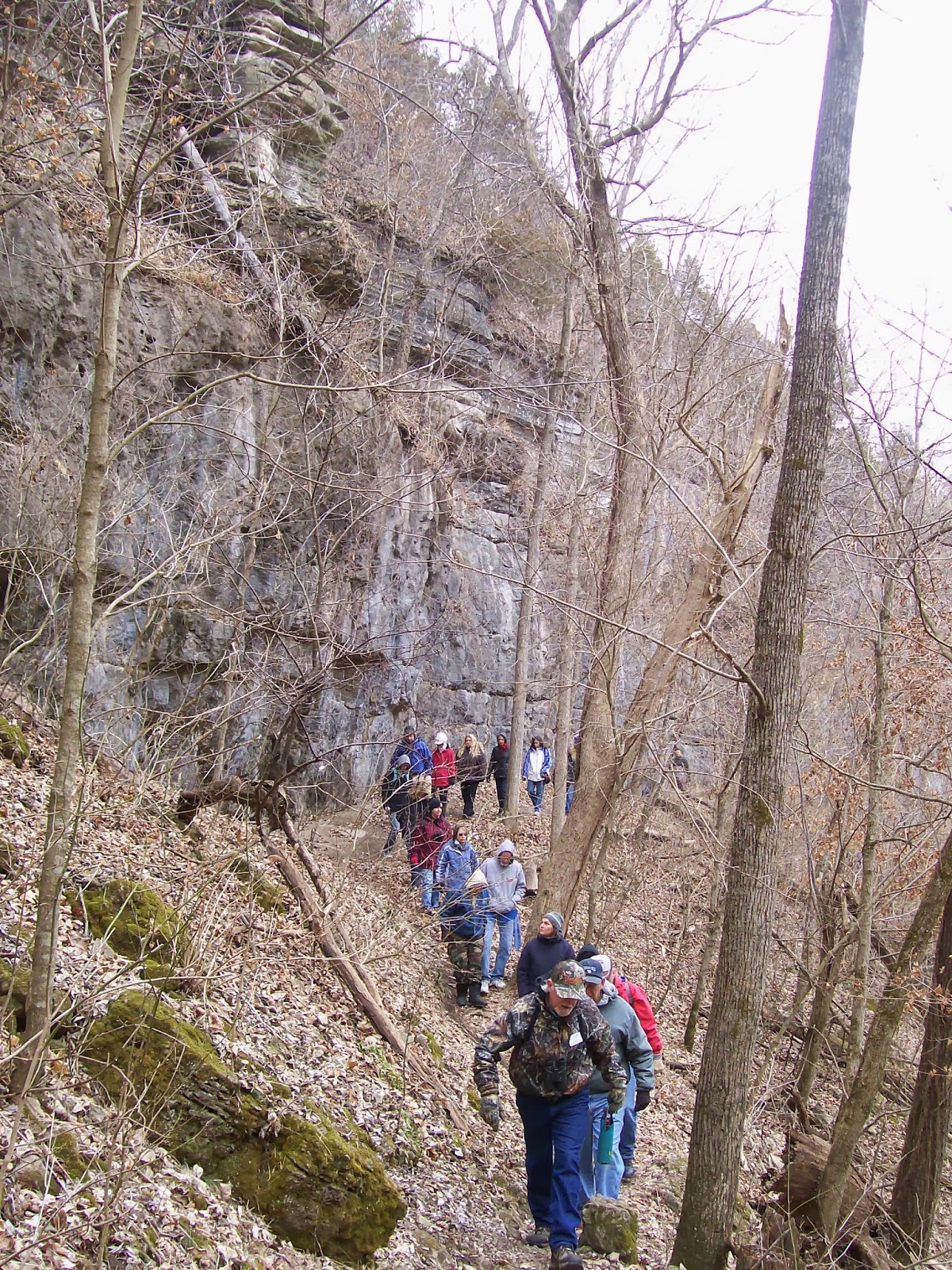
The Master Naturalist Class hikes along one of the largest Sinkholes called The Coliseum.


Here I am with a classmate on the other side of the sinkhole.  Previous photo with the Park Naturalist was taken where the wood fence is located in front of the Old Water Tower.  That's how BIG this sinkhole is!


View as our group descends above the Spring.  See the Castle remains on top of the ridge in the upper right corner?


The Spring is the dark green/blue water under the rock ledge.  It is 70' deep and produces 60 million gallons of water per day.  Dye-tests show 120 square mile area drains water to this site. 


View along walkway approach to Spring.  The average water temperature is always 56-58 degrees.  Today the water is warmer than the air.  There is always green plant growth in the shallow waters and it never freezes close to the Spring.  


This is the largest cave on the park.  When the park was first bought by the state in 1978, there were 20,000 bats counted by infrared cameras coming out at dusk.  Today the population is 120,000.  This can be attributed to gating the entrances to keep out predators and the shoot allows the bats to come and go naturally.  In early June, at dusk, anyone can come and sit on the steps/walkway nearby and wait for the many thousands of bats to come out.  This is a major location for reproduction.  

A Cave is a natural opening in the ground and is a geological feature; cannot have a cave without water.  The average temperature of caves in Missouri is 56 degrees with over 80% humidity.  Missouri is known as The Cave State because of the large number of caves; at least 6200.  Tennessee exceeds our count with 9000, but people are discovering about 100 more caves each year in Missouri.  Cave fish can live 60-70 years because there's no predators and they don't move around much so as to not expend energy; not much to eat.  There are 13-16 different species of bats.  People are no longer allowed to enter caves without special permits because White-Nose Syndrome is a fungus hurting the bat populations.  It doesn't affect people but people brought it here from Europe.  It is increasingly hurting bat populations and there is no cure.  Hopefully, a vaccine will be discovered for the bats.  The gray bat doesn't seem to be affected.

I've been to Ha Ha Tonka countless times since we moved to Missouri in 1978.  There is always something news to learn and see.  Just when I think I have seen it all, I see it again with new people and new perspectives and knowledge.  It is a great place to share experiences, knowledge and enjoy the camaraderie of new friends.

Monday, February 24, 2014

Great Call Award


This is a good time to recognize my husband, Keith, for the excellent work he does for the largest bank in the world as a Financial Advisor.  He recently received a Certificate of Excellence in recognition of an exemplary call servicing customers.  With it came an inter-office communication of High Importance from a Quality Analyst to upper management with the details.  In the eleven years Keith has worked for this bank, he does not recall anyone in any of the departments he worked in ever getting such a high award.  Good job, Keith!  I am so proud of you!


Sunday, February 16, 2014

The End of an ERA - RCA Out; LG IN


Our beloved 28-year-old RCA Stereo TV console has been replaced.  It is the end of an era and the beginning of something new…again!

1986 was the year we moved into our present home.  We had brought with us a 12" black and white TV with rabbit ear antenna that was our only TV for the previous seven years on our rural 50 acres and got two channels.  Shortly after we moved into our new home in town, we entered a contest to win a new TV console that was being given away to celebrate that Springfield Channel 10 was going "stereo" in their broadcast and this TV was the first to have the capabilities to use this new technology.  The deal was to count how many times the weatherman said "weather" on his nightly broadcast for a couple weeks.  So the family was all together at this dinner hour broadcast and we all counted and the entrees were sent in great numbers frequently.  The winner would be the closest number of days counted correctly.  We were so happy when Keith's name was announced as the winner!

Our neighbor, Clifford, worked at the local Chapman's Furniture store downtown and he got to deliver the console to our home after it was arranged by the TV station.  This was the biggest thing Keith had ever won and it sure got us up to date with our viewing!  Soon after, videos became available to rent and then we got a VCR.  We upgraded our outside TV antenna with a booster and was able to get six channels for free which was plenty for us along with the VCR; a big improvement from what we had on the farm!  That satisfied us well until our children were old enough to have developed good study habits and as a reward, we added another TV downstairs that included a Nintendo for gaming.  This was well after all their friends had one and not until they proved they could put their studies first.  This lasted all through the 1990's and when cable and satellite became available in our area, we declined as we had better ways to spend our money and enough entertainment which included mostly outdoor activities especially as the whole family got involved in scouting.  The children left home 1999 and 2000.  I began to travel much more especially with my job and Keith started a new career after getting a college degree.  TV was not so important and what we had was good enough for no more than we used it during the 2000's.

The only changes for the next decade was an increase in channels available for free especially when government changes mandated that all broadcasts were to be digital.  We got our two free converter boxes like everyone else in the country that hadn't updated their TVs.  We now had nine channels and new programming available; all free with our outside antenna and booster.  As of January 2014, we have 11 channels available and understand that there can be more in the future.  We had purchased a couple new small Smart LG TVs since 2011 and have been streaming movies through Netflix and Amazon for a few years now using the Internet and Wii.  The Wii system Keith had got free from saving points at his work; what a winner!  Finally, we have replaced the RCA console with a large Smart LG TV for Valentine's Day this year.  It is time.


Keith moves out our old family friend for 28 years - goodbye RCA!  


Not quite 'kicked to the curb' but out in the cold until the city picks it up during spring clean-up.  Not a bad run for being free!   Thanks for the memories, RCA, you had your day!

Friday, February 7, 2014

Environmental Issues for Appraisers


Winter 2014 is a good opportunity to complete Continuing Education (CE) requirements because as a General Certified Appraiser, I need 28 hours to keep my license which is renewed every two years by June 30th.  I understand that I have the option of going inactive since I retired and am not seeking employment.  The only benefit to the inactive status is that I could save $250 on the license fee which is normally $300 to be active.  I could also skip the 28 hours CE for one cycle but recently found out that I would have to take ALL skipped CE if and when I should decide to work in the appraisal field again.  If I went more than one cycle, the State of Missouri would void my license and I would have to have extensive additional education according to requirements for new applicants and apply all over again.  Not worth going inactive status until I am absolutely sure I don't want to work anymore.  I worked very hard to get where I am and as long as I am interested in the subject, I will keep it going.  I also have to keep my files available for 5-7 years so I will re-visit the option of going to inactive status no sooner than 2016-2017, the next cycle.

I have chosen McKissock as my online source for education as I had good experience the last cycle when I needed 8 hours of Uniform Standards of Appraisal Practice (USPAP). I had gotten 20 hours while I was still employed by the state at the state's expense.  I will be taking the updated version of this required class soon.  I like that McKissock offers interesting subjects and an option to pay $499.99 for an unlimited all-access pass that will not only have choices for minimum hours required, but allows the appraiser to go over the required CE hours at no extra cost.  So far I have chosen four CE courses that total 23 hours.  I will wait until I have completed those and then see what else interests me before the final completion date of June 30, 2014.  I have completed two CE courses to date and will blog about some things I found interesting enough to share.  They are Environmental Issues for Appraisers and Essential Elements of Disclosures and Disclaimers.


The first chapter is all about Radon, Mold, and Lead.  In the Appraiser's Certification statement, Item 14, speaks to the limitations of the appraiser's ability to identify environmental hazards.  It is wise to advise the client to have suspected hazards tested.  The appraiser should always disclose what they see or suspect.  Research is done through comparable market sales if an environmental hazard or suspected hazard has an affect on the value of the property.  The market measures value by comparing a non-affected property with a similar property of known or suspected hazard.  Testing can be done to determine the dollar amount to correct the hazard problem or show that suspected hazard is nonexistent.

Radon - The Environmental Protection Agency recommends getting house tested when buying or selling; some lenders require it as well as some local health agencies.  There is no uniform state or national legislation dealing with the radon issue.  Beginning in 2004, HUD required release agreement for all FHA insured mortgages.  Reducing radon levels of at least $5000 cost can be financed through a 203(k) mortgage.

Radon is the second leading cause of cancer.  Nearly one in every 15 homes in the US is estimated to have an elevated radon level in the dangerous level.  All 50 states in the US have some presence of radon.  There may be heavy concentrations in one property and none next door.


The course goes into much detail about radon testing for professionals as well as the do-it-yourselfers.  Radon mitigation can lower radon levels for $800-$2500 (average cost $1200).  There are some simple steps that can be done such as stopping radon seeping in by fixing cracks, exposed soil, and around sump pumps.  Also providing better outdoor air ventilation with exhaust fans or mechanical air exchangers.  A pro-active fix would be trapping and detouring the radon before it even gets into the house by sub-slab suction which is basically drilling a hole in the basement floor, install 4" plastic pipe that runs through a wall or closet and up and out.  Cost to run a fan and any heat loss would be $100-$150/year.   In new construction, cost to install passive radon-resistant features run as low as $100 but typically range $350-$500.  Only about 1% of radon in the air comes from drinking water such as when showering and the particles become airborne.  Stomach cancer is rare from direct drinking unfiltered water with radon.

Mold - Most homeowner insurance policies specifically exclude mold as it is a natural occurring organism that helps sustain animal/plant life as well as parasitic relationships and consume their host.  Some can be toxic to some humans.  Symptoms range from itching eyes and runny noses to triggering asthma attacks and flu-like symptoms.  Most serious can cause neurological disorders, cancer, and death.  The key to controlling mold is to control moisture.  It also needs a food source of organic material and favorable temperature (40-100 degrees).  If any of these three ingredients were removed, the mold colony can simply become dormant up to 10 years.  Add back the missing ingredient, mold comes back to life.


Water-damaged areas must be dried within 24-48 hours to prevent mold growth.  Hard surfaces can be washed with detergent and water and dried completely.  Absorbent materials such as ceilings and carpet may have to be replaced.  All mold materials can be taken to a dump without special permit.  Construction practices since the 1970's led to tightly sealed buildings with inadequate ventilation.

Molds can be readily observed and usually smells.  Wherever there is likelihood of finding moisture, look for mold.


Lead - In it's natural state, lead is not a problem.  Once it has been processed there is no known way to dispose of it or render it harmless.  Lead is toxic and can accumulate in bones and soft tissues over time; many documented detrimental health issues especially in children. The older the home, the likelihood it has lead-based paint.   1978 is when lead-based paint was banned in the US.  In good condition, lead paint is not a hazard but the potential is there if it is disturbed such as in remodeling. Since EPA started Lead Awareness Program, lead blood levels in children have dropped to 310,000 in 2002 from beginning 13.5 million in 1978.  It works!  In 1992, Congress passed Title X, Sec 1018 which extensively regulates ratification of contracts for housing sale/lease by sellers and landlords to disclose lead, not test or repair any lead-based problems.  Appraisers know what to look for and will disclose all observations for potential lead-based issues.  EPA estimates about 64 million homes contain lead-based paint.


The second chapter goes into great detail about Asbestos, Underground Storage Tanks (USTs) and Above-Ground Storage Tanks (ASTs), Water Issues and Hydraulic Fracking, Superfunds and Brownfields, Indoor Air Quality, and Home Design & Building Techniques That Reduce Waste.

Asbestos - Most products today do not contain asbestos which is a natural occurring, fibrous silicate mineral mined for useful properties such as thermal insulation, chemical/thermal stability, and high tensile strength.  Microscopic fibers may become airborne when damaged or disturbed, inhaled into lungs and can cause significant health problems similar to radon lung problems.  Like radon, it may take 20-30 years after exposure for symptoms and is greater risk to smokers.  Until the 1970's many types of building products and insulation materials used in homes contained asbestos.  Houses built between 1930-1950 may have asbestos as insulation; textured paint and patching compounds were banned in 1977.  There is more information available on the EPA website to identify common products that may have contained asbestos in the past and guides about handling, testing, and legal aspects.   The best advice is to LEAVE IT ALONE.  If material break down or crumbles easily it is called "friable" and requires action.  Leave it to professionals using two separate firms:  testing/assessment and correction to avoid conflict of interest.   

Two types of correction include repair and removal.  Repair involves sealing or covering and is cheaper than removal but may make later removal more difficult, if necessary.  Removal is most expensive method and should be considered last option if it is required by state or local regulations.  Call the professionals if removal job is bigger than your hand.  Keep material wet to reduce likely airborne fibers.  Appraisers should always err on side of caution calling for additional inspections when suspect or may risk legal problems in future.


Underground Storage Tanks (USTs) - defined by EPA as having at least 10% of their combined volume underground.  Estimates are that about 25% of all USTs are leaking; commercial and home fuel oil.  Prior to mid-1980's, all USTs were made of bare steel which corrodes.  Tank removal must be under supervision of proper authorities, cleaned and disposed properly; very expensive.  Contaminated soil must be placed in drums and shipped to hazardous waste disposal site.  Some recent technology allows treatment with bacteria that eats up oil.  Permanent closure of site and record keeping for at least three years of actions taken after determination of contamination was positive is required by EPA.  Because of enormity of the problem, EPA delegated regulatory authority to approved state programs.  Only 29 states with approved UST programs submitted since 1988.  As of 9/30/2006 over 460,000 confirmed releases had been reported and more than 350,000 have been cleaned up.  There's about 113,000 UST sites remaining to be cleaned up.  Above-Ground Storage Tanks (ASTs) are also subject to both Federal and State/local regulations.

Water Issues and Hydraulic Fracturing ("Fracking") - this section breaks down how important water sources are and connects them to public and private use.  The definition and importance of wetlands is defined by the Clean Water Act Section 404.  The US loses about 60,000 acres of wetlands each year.  Wetlands are among the most productive ecosystems in the world similar to rain forests or coral reefs.  They help to moderate climate conditions by storing carbon instead of releasing carbon monoxide; also plants generate oxygen.  Often they are situated between upland and downstream outlets so serve as a settlement for contaminants.  See how Wetlands Work for Us at: Earthgauge

"Fracking" is used in the development of shale gas and coal bed methane.  Water used in process may be impaired and can be treated on-site and reused.  Excess return water may be piped/trucked to nearby municipal water treatment plants and can largely impact local treatment centers.  May impact water quality in rural areas more.  Public concerns range from welcoming the energy industry recognizing the energy need to NIMBY (not in my backyard) concerns of those citizens with limited exposure to oil, gas, or coal operations.

 The black circle with the toxic skull areas show "Fraccidents" or areas where fracking caused problems.  The brown areas show active and potential natural gas drilling and fracking.


Groundwater is protected by the EPA's Groundwater Rule since November 8, 2006 which provides increased protection against microbial pathogens in public water systems that use groundwater sources; especially fecal contamination.  Storm water, lakes, rivers, streams, oceans, coasts, estuaries, beaches and water rights are discussed in depth on their direct and indirect influence on property values.  Regulations have increased since the 1970's with a most recent presidential Executive Order 13547 that establishes the Nation's first comprehensive National Policy for stewardship of the ocean, our coasts, and the Great Lakes.  EPA is now in process of working with Federal, State, and tribal partners to coordinate efforts in implementing goals outlined in EO 13547.  

Appraisers should use the National Wetlands Inventory maps in the appraisal exhibits just like one would use a Flood Map.  Market-driven conclusion of value demands evidence on either side of the asset.  Highest and Best Use must be analyzed as well as potential mitigation.

Superfunds and Brownfields - EPA definition is any land in the US that has been contaminated by hazardous waste and identified by EPA as a candidate for cleanup because it poses a risk to human health and/or the environment.  Identification and prioritization are at the core of the Superfund program.  As of November 29, 2010, there are 1280 sites on the National Priorities List (NPL) and are in every state.  Extensive information is available about the process of identification and prioritization  through the EPA website.  Brownfields are sites that have suffered previous contamination.  The EPA estimates about 500,000 Brownfields nationwide; most common contaminant is petroleum. 

Indoor Air Quality - The air-tight construction of buildings since the oil/gas crisis in 1973 has produced buildings that couldn't "breathe" very well and trap moisture and/or irritants or hazards and become concentrated.  Many buildings were built with no windows or windows that don't open in climate controlled environments.  Some of the pollution sources found indoors include carbon monoxide, tobacco smoke, organic gases from household products, pesticides, volatile organic compounds (VOCs) such as formaldehyde which has many sources (new carpet, plywood, paneling, cabinets, draperies, etc).  That "new car smell" is formaldehyde.  Ventilation is important to dissipate.

Home Design & Building Techniques -  This section has mainly EPA suggestions for advanced and efficient framing techniques for new homes or additions that can be found on their website.  It includes designs for new homes that consider deconstruction/renovation using fewer materials to realize design for salvage materials and using fewer adhesives/sealants.  Basically, to maximize the value of a building's material while reducing environmental impacts; easier to rearrange, recover, and reuse.  I have previously completed a CE course on Green Buildings which you can see from this blog by using the "Search This Blog" tool on the right side of the main page or click on the Real Estate Issues Label and see more related issues.

The final chapter of this course goes into more appraisal specific issues mainly on environmental reporting.  This is the technical area relating to USPAP and government reporting forms for VA, FHA, Fannie Mae.  Sources for additional information are given.  The best and most useful website for specific environmental hazard locations using Geographic Information Systems (GIS) can be found at the EPA EnviroMapper. 

The second CE course I took was Essential Elements of Disclosure and Disclaimers.
Most of this I already knew as it is part of USPAP.  Here we get into exactly how the appraiser must comply and real world examples of reporting.  The best site to understand this importance is the Liability Insurance Administrators.  This is one big reason why it is not in my best interest to continue working in the appraisal field as an independent.  Although I have been a Limited Liability Company (LLC) since January 2003, the cost of the E&O insurance would be something I had never had to incur in the 30 years I had worked as a salaried  employee for the state.  They had me covered.  The level of liability has greatly increased in recent years as the regulations for lenders increased and the reporting requirements are practically insatiable for the appraiser.  Yet the price per appraisal has not increased much since the 1990's; $250 then to about $350 per residential appraisal now.  Also, I am seeing and hearing from peers that appraisers are expected to pay additional fees to lenders to be on their lists for work.  It is not worth it to me as a retired appraiser who worked during the best of times before a few bad appraisers and lenders messed it up for everyone with their dishonest practices that brought down the Savings & Loan Institutions in the 1980's and distorted the economy in the 1990's.  It all finally fell as corrections needed to be made by 2008; BAM!  We now need more regulation than ever to protect the consumer so it doesn't happen again and continuing education to keep up with all the changes.  

My primary experience has been as a Commercial Appraiser which includes all real estate that is not residential or agricultural although I have to know how to value all uses in order to break out the specific commercial use in mixed-use properties. I have done all uses in my 30-year career and was responsible for all property values in 114 counties and the City of St. Louis as manager.  It was a golden time to be an appraiser during 1981-2011 especially working for the State of Missouri where I was in a position of monitoring the assessment offices as a retrospective appraiser and then implementing changes as Ratio Manager.  I have never worked in the private sector.  Legally, the private sector looks a little scary to me to be an independent appraiser/consultant in this time of high reporting regulations and lawsuit potentials.  According to my peers, collecting your fee from clients and constant legal challenges take all the fun out of the profession in current times.  Good luck to all those young appraisers starting their careers who never knew the profession in a time of honest disclosure and trust.  Intuitive Value was respected.